

Additional information
| Artist | Glazunov |
|---|---|
| Nationality | Russian |
| Category | Soviet / CIS |
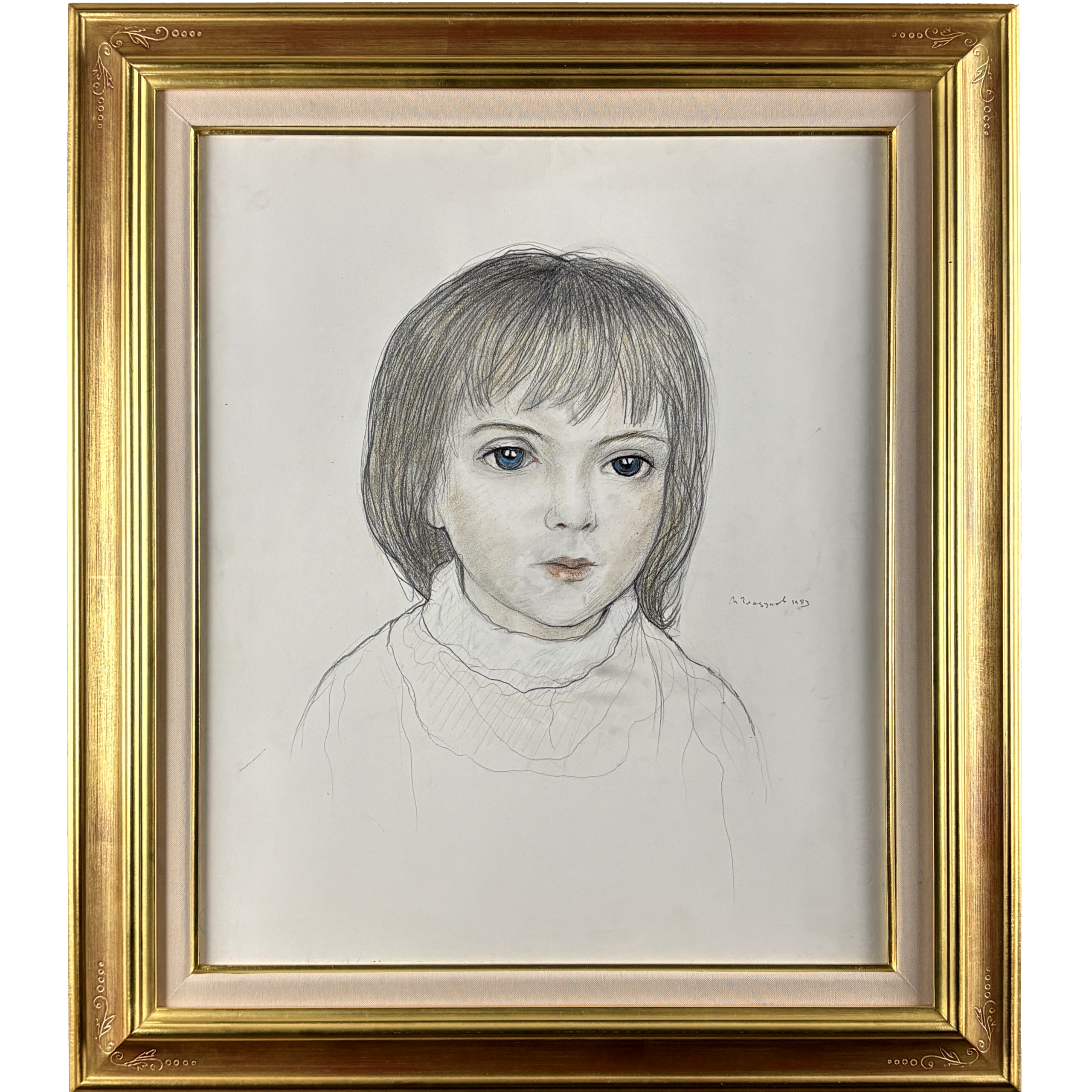


ArtistGlazunov, Ilia Sergeyevich
Artist Years1930-2017
Artist NationalityRussian
Yearca. 1960
MediumDrawing > Mixed Media
DimensionsComposition: 14 X 10 inches
Sheet: 17 X 15 inches
Conte crayon, graphite, watercolor, and gouache on white wove paper, signed and dated center right.
Accession NumberRC2201
Notes1930- 1939
llya Sergeyevich Glazunov was born to the family of scholar Sergey Fyodorovich Glazunov and Olga Konstantinovna Glazunova (nee Flug). He is enroLLed in a children's school of art, and Later attends secondary art school in the historical district of Petrogradskaya Storona.
1940- 1949 During World War II, known as the Great Patriotic War, both of Glazunov's parents perish during the Leningrad Blockade. Eleven-year-old llya Sergeyevich is evacuated to safety in the North (Bolshaya Zemlya). At his new residence in the Novgorod region, Glazunov attends school and creates drawings based on Life in the countryside. When the war ends, he returns to St. Petersburg and enters the school of arts under the auspices of the I. E. Repin Institute of Painting, Sculpture and Architecture. Here heimmerses himself in painting and visits Tallin, Moscow and Kiev. At the Kiev-Pechersk Lavra, elder Father Tikhon dissuades the artist from taking the vow of monkshood and confers his blessings upon him to Live in the outside world.
1950- 1959
Glazunov studies at the I. E . Repin Institute of Painting, Sculpture and Architecture, and engages in student field training in Yukki, Vasil'sursk on the Volga, Plyos, and Uglich, as well as the construction site of the Kuibyshevsk Electric Power Station. He paints his diploma work, "The Roads of War; which is rejected by the academy's administrative board. He meets and marries Nina Aleksandrovna Vinogradovaya-Benois. Glazunov forms an acquaintance with L. L. Obolensky, talks with whom spark an interest in the personality of Dostoyevsky and early Russian painting. He creates the work "Dostoyevsky in St. Petersburg," as well as illustrations to the novels "The Idiot" and "Demons." He is awarded the grand prix in an international competition of young artists organized by the journal "World Student News." He holds his first one-man exhibition in Moscow at the Central House of Workers of the Arts, which becomes the subject of much controversy.
1960- 1969
Glazunov elucidates his creative position in articles in the press and in an autobiographical book "The Road to You. From the Artist's Notes.· He travels widely and works in the Russian North. Through his paintings he expresses his understanding of the Old Russian historical and cultural legacy. He travels to Italy at the invitation of honored Italian workers of culture. He is accepted into the organizing committee
of the All-Russian Society for the Preservation of Historical and Cultural Monuments (VOOPik). He becomes the organizer and director of the "Club for Enthusiasts of Old Russian Art" which was later renamed "Rodina" (Homeland). He works on illustrations to the works of Kuprin, l..ermontov, and A. K. Tolstoy. His exhibition housed in the administrative quarters of the Central Exhibition Hall in Moscow (Manege) is shut down five days after opening at the orders of the Moscow Artist's Union. He paints the portraits of the 13th Patriarch of Moscow and All Russia, Aleksy I (Simansky), and other members of the Russian Orthodox Church. He visits and holds exhibitions in Copenhagen, Paris, and Laos. During a trip to Vietnam he creates over 150 works: "The Vietnam Series." He is accepted into the USSR Artist's Union.
1970- 1979
He draws illustrations to works of Dostoevsky, Nekrasov, Blok, l..eskov, and Goncharov. Glazunov's first Leningrad exhibition, held in the District Officer's Building, is ordered shut down by the Leningrad Regional Party Committee. The first monograph about the artist is published. He takes a creative trip to Chile, and travels to India. The artist's daughter Vera is born. He travels to Finland for an exhibition in
Helsinki followed by one in Stockholm, Sweden. Exhibitions are held in cities of the Federal Republic of West Germany (GDR) and the German Democratic Republic (FRG). The artist is awarded the "Golden Medal," the highest award of the Society of German-Russian Friendship. A creative "exile" to Siberia, to the construction site of the Baikal-Amur Railway, results in the series "BAM." He visits the Optina Monastery (Optina Pustyn). An exhibition is held in Moscow at the Manege, and another in Tokyo. Glazunov collaborates with his wife on the stage design for Borodin's opera "Prince Igor'" at the Berlin State Opera. He begins teaching at the Surikov State Art Institute in Moscow. As the 600-year anniversary of the Kulikovo Battle approaches, he works feverishly on the series "Kulikovo Field."
1980- 1989
Glazunov is awarded the title "People's Artist of the USSR. He collaborates with his wife on the stage design and costumes for Tchaikovsky's opera "Queen of Spades" for the Berlin State Opera. He works on stage design and costumes for the ballet "Masquerade" with music by A. I. Khachaturian for the Theater of Opera and Ballet in Odessa. He serves as artistic set manager for Rimsky-Korsakov's opera "Tale of the Invisible Town of Kitezh and the Maiden Fevroniya" for the Bolshoi Theater in Moscow. Exhibitions of Glazunov's work are shown in major European capitals, as well as Russian and Ukrainian cities. He continues work on illustrations to a 12-volume collection of Dostoyevsky's works. He takes a creative sojourn to Nicaragua, where he creates the "Nicaragua Diary" series of works. He visits Cuba, and paints a
portrait of Fidel Castro. An exhibition at the Moscow Manege showcases 30-years of the artist's works. Glazunov is appointed rector of the institute founded by him - the All-Russian Academy of Painting, Sculpture and Architecture. A film about the artist, The Artist and Time," is released.
1990- 1999
Glazunov travels with a group of students to Italy, where he paints a portrait of Pope Paul IV. He creates the works "Apocalypse. The Blind Sower," "The Wind," "The Great Experiment," "Glory to our Forefathers," "Sergei Radonezh and Andrei Rublev," Dostoyevsky," "Christ in the Garden of Gethsemane," "My Life," and "Russia, Awaken!" Exhibitions are held in Perm, Sverdlovsk, Kuibyshev, Syktyvar, Dnepropetrovsk, Kislovodsk and Krasnodar. The documentary film "The Russia of llya Glazunov is released. He is awarded the Order "For Merit to the Fatherland" IV class. Glazunov wins in an architectural design competition for the reconstruction of the 14th Building of the Moscow Kremlin. In a public poll taken by VTSIOM (the Russian Public Opinion Research Center), he is named "The Most Outstanding Artist of the XX Century." UNESCO awards the artist "the Golden Medal of Picasso" for his great contribution to culture and art. The exhibition "God Preserve Russia" opens in the Moscow Manege.
2000- 2017
The artist is awarded the Order for Merit to the Fatherland, 3rd, 2nd, and 1st class, for outstanding contributions in the sphere of domestic fine arts and education. A documentary film about Glazunov's life and work, "Black Water, White Block of Ice," is released. The Moscow State Gallery of People's Artist of the USSR, llya Glazunov, opens its doors on 13 Volkhonka Street. He is awarded the Order of St. Andrew the Apostle, "For Faith and Loyalty." Glazunov's gallery is visited by Patriarch Alexy II and Metropolitan Laurus of New York, First Hierarch of the Russian Church Outside Russia. At the Moscow Manege an exhibition opens to commemorate the artist's 80th birthday, together with a photo exposition entitled "The Artist and Time." The Russian Orthodox Church awards Glazunov the Order of Andrei Rublev, 1st Class.
(source: P. Y. Klimov)
| Artist | Glazunov |
|---|---|
| Nationality | Russian |
| Category | Soviet / CIS |