

Additional information
| Artist | Cautaud |
|---|---|
| Nationality | French |
| Category | Surrealism, European |

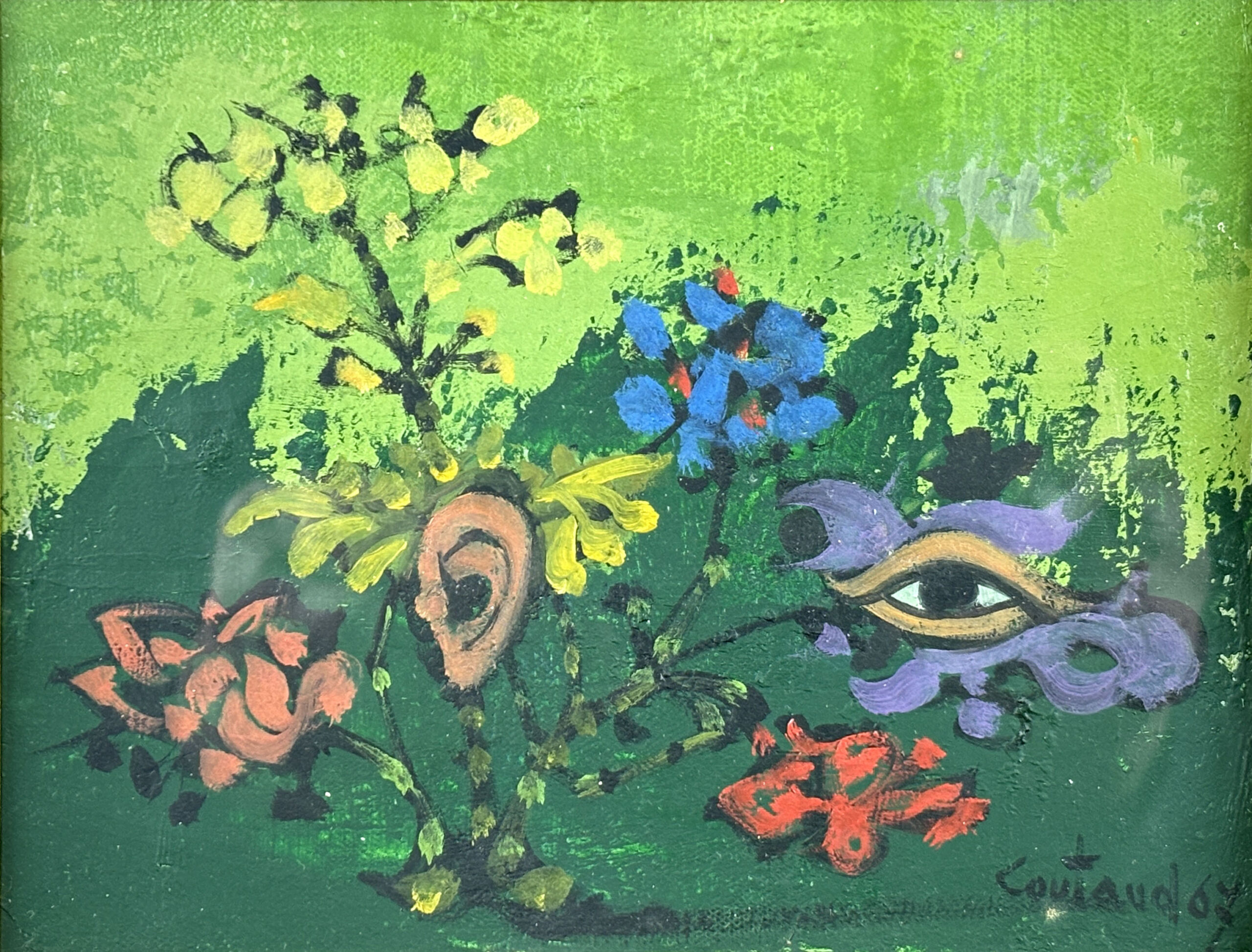


ArtistCautaud, Lucien
Artist Years1904-1977
Artist NationalityFrench
Year1967
MediumPainting > Oil
DimensionsCanvas: 5 X 7 inches
Oil on canvas, signed and dated lower right corner.
ProvenanceGalerie Nichido, Tokyo.
Accession NumberRC1865
NotesLucien Coutaud (13 13décembreDecember 1904 – Gard21 June 19771977) was a French painter and engraver. Alongside his career as a painter, he worked as a decorator for theatre, dance and opera and he also had an activity as a tapestry cardboard company in the context of the revival of Aubusson's tapestry.
Lucien Coutaud was born in a small town in the Gard, between Nîmes and Beaucaire. His father Adrien Antoine Coutaud is a watchmaker-jeweller in Nîmes. His mother Françoise Célestine Priad is from a former Meynoise family. He spent his childhood and adolescence in Nîmes, apart from a short stay in Marseille in 1917. Soon enough, he manifests a character worried, secret, anxious, different from his comrades and aware of his difference; he is a man tormented, complex and generous at the same time. From the end of his schooling, and after having made a watchmaking apprenticeship with his father, he joined, in 1920, the school of fine arts of Nîmes, where does the engraver profess Armand Coussens. In the same year, he took a passion for bullfights, the supreme confrontation of life and death, with his friend Albert Dubout, of which the humorous drawings, but also illustrations and posters will mark several generations.
In October 1924, at the age of twenty, Coutaud went to Paris. He attended the academies of Montparnasse. He is welcomed by the writer Marc Bernard. This young Nîmois is interested in the Primitives of the Louvre, as well as in Chirico, Max Ernst and Paul Klee. In 1925, he made during his holidays in Nîmes the acquaintance of André Fraigneau for whom he illustrates Spectacles, his first book published by Jo Fabre. He was received at the School of Decorative Arts. In 1926, on the advice of André Salmon, he met Charles Dullin who asked him to realize the decorations and costumes of the Birds, the piece of Aristophane, adapted by Bernard Zimmer, while he left towards the end of the year to perform his military service, first in Saint Cloud, then in Mainz in Rhineland.
In April 1928, he returned to Paris and, in 1929, painted his first important canvases: La Bicyclette, Femme et soldier, Soldiers arresting a spy, Young girl with three wheels. Rose Adler is interested in her work.
In 1930, he made his first engravings, at the dry tip on zinc: Souvenir de Rhénanie, Trois amazones, La Cycliste, Le Matin. He has a relationship with the writer Jean Blanzat.
In 1931, the Galerie des Quatre Chemins, in Paris, organized his first private exhibition. He befriends Jean-Louis Barrault who made his stage debut at the Théâtre de l'Atelier.
In 1932, he worked almost exclusively on the gouache, painting many bouquets of flowers and large esoteric compositions. Decorations and costumes for Le Château des Papes d' André de Richaud directed by Charles Dullin at the Théâtre de l'Atelier. Decorations for Venus and Adonis by André Obey directed by Michel Saint-Denis and represented by the Compagnie des Quinze. He is interested in the activities of the surrealist group, reads Breton, Soupault, Aragon ... but does not commit to keep his independence.
In 1933, he made boxes of seats for Marie Cuttoli.[N 1]] In 1934, he exhibited a set of gouaches and drawings, from 9 to 22 March, at the Vignon gallery in Paris directed by Marie 1Cuttoli 1.
In 1935, he maintained friendly relations with James and Peter Prevert as well as with Jean Aurenche known since 1929. He meets Matisse and Picasso to Antibes. For a bibliophile, Mrs. Solvay, he illustrates the gouache Legendary Moralities of Jules Laforgue. Marie Cuttoli1 orders him a large cardboard of tapestry: Paul and Virginia.
In 1936, he married Denise Bernollin (1905-1986) on 7 April, a Parisian artist who had met six years earlier. The Jeanne Bucher-Myrbor gallery organizes a special exhibition in November.
In early 1937, he moved to 7 rue Antoine-Chantin. He executed a large mural, The Myth of Proserpine, for the Palace of Discovery (it was destroyed in August 1944, during the bombings of Paris). Illustrations for several poetry booklets published by Guy Lévis Mano:
He contributed by an illustration to the notebook published on the occasion of the performances of Ubu enchaîné directed by Sylvain Itkine at the Comédie des Champs-Élysées.
In 1938, he created for Dullin, at the Atelier, the sets and costumes of Plutus, inspired by Aristophanes. The same year, Jacques Copeau asks him to realize the decor of As you like from Shakespeare, for the musical May of Florence.
During the Second World War, Coutaud continued his activity as a tapestry cardboard firm for the Compagnie des Arts Français directed by Jacques Adnet, while focusing mainly on painting.
In 1941, he participated in the exhibition Twenty young painters of French tradition at the Braune gallery and he created for Barrault the sets, accessories and costumes of 800 meters, by André Obey, played at the Roland-Garros stadium.
In 1942, he made the cardboard of the Orpheus tapestry and the muses and at the end of the year, he moved to 26 rue des Plantes.
First Salon of May.
In 1943, he designed the sets and costumes for Paul Claudel’s Saulier de Satin, directed by Jean-Louis Barrault at the Comédie française. In 1944, he was one of the founding members of the May Salon.
In 1945, he exhibited a large canvas from 1944 at the first Salon of May: The Seven Irons. He created the sets and costumes of the Poet, a ballet by Boris Kochno, mounted at the Sarah Bernhardt Theatre by Roland Petit. He stayed in Collioure during the summer at the invitation of Willy Mucha. He presents at the Salon d'automne En rase campagne, a young bread bearer metamorphosed into a chair.
In 1946, a private exhibition at the beginning of May at the Roux-Hentschel gallery in Paris. New stay on the Catalan coast during the summer. He presents at the Salon d'Automne a large canvas titled L'Escalier by Mademoiselle Phèdre.
In 1947, private exhibition gallery Bonaparte in Paris in January, and at the end of the year gallery Jérôme in Brussels. It illustrates four etchings Rue de la Gaîté, Voyage en Bourgogne by Robert Desnos, published by Les 13 Épis. He meets Boris Vian who will later dedicate to him a poem entitled Les isles . He goes to Lacoste in August to admire and draw the ruins of the castle of the Marquis de Sade.
In 1948, he signed the sets for the ballet Spring Games, set to music by Darius Milhaud at the Opéra-Comique. He spent the summer in Brittany in Belle-Île-en-Mer. He exhibited at the Maeght gallery in Paris for the presentation of Gilbert Lely's My Civilization illustrated with eleven etchings made the previous year. Alain Resnais shoots a short film about his work.
In 1949, he engraved a large etching, Young Person from the vicinity of Joucas, for the International Guild of Engraving. Second stay in Belle-Ile. Decorations and costumes for Elisabeth of England by Bruckner directed by Jean-Louis Barrault at the Théâtre Marigny.
In 1950, he painted the sets and costumes of the Elements, a ballet by Serge Lifar presented at the Versailles Music Festival. In the same year, he illustrated A Season in Hell by Arthur Rimbaud, at the request of the company Les Bibliophiles de France.
In 1951, he finished illustrating seven etchings A Season in the Hell of Arthur Rimbaud for the Hundred Bibliophiles of France and Overseas Book-Lovers (New York). He participates in numerous group exhibitions: Tokyo, London, Buenos Aires, Sao Paulo. The Rive Gauche gallery dedicates a retrospective to him from May 31 to June 19. He painted during the summer on the banks of the Loire of the "Loirarbres" and "Citarbres".
In 1952, he participated in Saarbrücken in the exhibition Painting Surréaliste en Europe organized by Edgar Jené.[N 3]] A stay in Trouville during the summer makes him discover the English Channel. He brings back many gouaches.
In 1953, he was dedicated to the Museum of Modern Art in Kamakura, Japan, and made the sets and costumes of Cherubini's Médée, performed by Maria Callas, directed by André Barsacq, at the May musical in Florence. On his return from Florence, he stayed in Venice at the Palais Polignac. He participated in the exhibition "Fantastic Art" organized in Ostend. First stay during the summer in his Norman residence, near Villerville, facing the estuary of the Seine: the Horse of Brick. This place will now be his main source of inspiration.
In 1954, he composed Aqua, a cardboard tapestry for the French Steel Trade Union Chamber. He always participates in many exhibitions. In particular, he presents nine paintings in the Fantastic Art section of the Venice Biennale. He paints several important paintings: Eroticomagia, Eroticomagia Beach, Corrida Eroticomagical which will be acquired by the Viscountess Marie-Laure de Noailles, Eroticomarine.
In 1955, he created sets and costumes for Paul Claudel's Protée. Sagittarius Gallery Exhibition in New York. Decorations and costumes for Jeanne d'Arc by Charles Péguy at the Comédie-Française.
In 1956, Paysage taurin exhibited at the Salon de May was acquired by the Musée d'Art Moderne de la Ville de Paris. It illustrates fourteen etchings The White Bull of Voltaire for the Comtois Bibliophiles.
In 1957, he continued to paint many bullfighting and bullfighting scenes. The Château Fadaise, then the fish and ships composed of intertwined bodies appear in his works.
In 1958, cover of Paul Claudel's Soulier de Satin by Jean-Louis Barrault at the Théâtre du Palais Royal for which he recomposes the sets and costumes. On November 5, he painted the first angel dedicated to the Cathars.
In 1959, the David and Garnier gallery devoted a particular exhibition to him, mainly on the theme of women-flowers, characters composed of thoughts and iris.
In 1960, he painted the boxes of three large tapestries Jardins exètes for the Paquebot France. Decorations and costumes for The Trojan War will not take the place of Jean Giraudoux. He travels to Moscow and Leningrad for the presentation of the play. First catalogue of his work engraved and lithographed with a preface by Jean Adhémar at Pierre Cailler in Geneva. After a stay in Montauban, travels to Montségur and other Cathar high places.
In 1961, he presented at the Salon de mai Taureaumagie cathare. Private exhibition at the Oberhausen Museum. The village of Sauve, its forks and the castle of Roquevaire enter his painting.
In 1962, private exhibition in February gallery André Weil where appear Wavemakers and Beautiful demoiselles de mer. Retrospective in May - June at the Galliera Museum with Félix Labisse and Robert Couturier. He draws the sword of academician by Jean Guéhenno.
In 1963, he went to Japan where he exhibited at the Nichido Gallery in Tokyo a set of paintings and gouaches from 1957 to 1963, an exhibition presented later in Osaka and Nagoya. In October, the cover of the Satin Shoe by Jean-Louis Barrault at the Odéon-Théâtre de France for which he once again completely recomposes the decorations.
In 1964, he participated in the exhibition at the Charpentier gallery in Paris. He invented the Nîmois and the Nîmoises, characters often composed of architectures. A monograph is dedicated to him by Pierre Mazars at Pierre Cailler. In October, he was appointed head professor of Etching Workshop at the École nationale supérieure des beaux-arts in Paris, a position he held until 1975.
In 1965, retrospective from July 3 to September 30 at the Château-Musée de Cagnes-sur-Mer. He continued to paint Nîmoises and also composed Normans and Damarbres. Takes interest in the mystery of the Templars.
In 1966, he moved in November, 8 rue Garancière, near the Place Saint-Sulpice.
In 1967, the grand painting prize of the city of Paris was awarded to him for Pigeon of July 25, 1966. He travels to Cuba in July with the painters of the May Salon. In 1968, he participated in July in the exhibition Trésors du Surréalisme at the casino of Knokke-le-Zoute. He paints many compositions on the theme of hands and ears.
In 1969, he discovered the island of Jersey and his swans at the beginning of the year. Important retrospective of his works from June 27 to September 30 at the Ingres Museum in Montauban. Goyert Gallery Exhibition in Cologne from 6 November to 6 December. In 1970, he composed rocks, houses, monuments made of accumulated bodies.
In 1971, he made a frontispiece for Château where Dieu was another by René Nelli at Fata Morgana. The Voyage dans la Lune de Cyrano de Bergerac, which it illustrates with twenty etchings, is published by the Club du Livre. He paints in July an important canvas: They seek the twilight. At the end of the year the Grand Prize of the Academy of Fine Arts was awarded to him.
In 1972, sets and costumes for Eric Satie's Socrates at the Opera in Marseille. Decorations and costumes for the Fourth Day of the Satin Shoes (or Sous le vent des Iles Baléares) performed in October at the Théâtre d'Orsay by the Compagnie Renaud-Barrault.
In 1973: exhibition from January 26 to February 24 of a set of gouaches and engravings at the Dantesca Gallery in Turin. He paints several paintings on the theme of marine sleepers.
Lucien Coutaud died in Paris on 21 June 1977. According to his will, he is buried in the small cemetery of Meynes near his mother.
Coutaud’s figurative style, which evolves towards dreamlike abstraction, is close to a surrealism with southern themes and colors: poetry of bullfighting, dramaturgy of death. This poet-painter who was the friend of Jean Blanzat, André Fraigneau, Marc Bernard, Jean-Louis Barrault, Óscar Domínguez, Paul Éluard, Pablo Picasso, Jacques Prévert, Boris Vian, Gilbert Lely, Jean Paulhan, Yves Tanguy, Félix Labisse and Jean-Paul Sartre has repeatedly claimed his independence.
Lucien Coutaud invented the concept of "eroticomagy"[[1], a painting centered on a world, on an individual constantly delivered to the metamorphosis, but always sexual, in the image of the series of Taureaumagies, made of intertwined bodies, or that of the Swan Characters, and who feels pushed to blend in, without always succeeding, and at the risk of getting lost in it Eroticomagy is the carnal and dreamlike fusion of eros and magic, of reality and dream, of the painter and of his inner world.
Lucien Coutaud has noticed that "if we look at an object for a long time, there comes a time when attention is tired and when we no longer think of this object, but of another, often very distant, sometimes unrelated to the first, but to which we think with pleasure. He paints this association of the real object and the object he imagines.” He makes another remark: “When, after having contemplated an object for a long time, attention is paid to another, the shape of the first is communicated to the second. She's contaminating him. If we take, for example, the shape of the bull and that of the bull, and be contemplated, man before the beast, it takes on a human aspect. This is why, to represent a bull, Coutaud makes an amalgam of human bodies to which he adds two horns and hooves.” Thus, observes Yvon Taillandier, "the bull, symbol of manly power, suggests to Coutaud the idea of bodies entangled and entangled. So that the bullfighting scene becomes, to use this word that he invented, a scene of [eroticomagy".
The great periods of Coutaldian painting
This period began as Coutaud performed his military service at Mainz between 1926 and 1928. He then discovers the landscapes and the Rhine skys from which he will bring out his famous “blue Coutaud” (milky blue that recalls the gray of the skys), like its androgynous characters, like Girl on three wheels, an oil on canvas from 1929.
On the canvases, we see many characters with bluish shapes, hesitant, worried, vulnerable, soldiers, but also women, spies. Already, anxiety, the closed world are arguing for dreamism.
This period is almost exclusively made up of gouaches. Coutaud’s palette is enriched considerably. The reds, but also the southern blue or the marine green, are beginning to prevail. The drawing becomes more precise and sketches of the forms that will be specific to the style of Coutaud, whose favorite themes are then the boat wandering in a dreamlike landscape, the horse, the first bouquets of flowers, the musicians who are the brothers of the poets, from the melancholy characters with sharp, sharp, as fantastic as they are enigmatic, and who seem to have escaped from the scene of a theater.
Ésotérisme[Esotericism[3]? Coutaud’s work, without being directly related to it, has a relationship with magic, and also with the esoteric tradition, as evidenced, for example, by his tribute to Josephin Peladan, including the copper-water on Au Sar Péladan, of 1951, and the oil on canvas Adorno dedicated to the Sar Péladan, of 1957. In addition to the reference to the extravagant Peladan, Coutaud has work-homages, such as the tapestries La Maingique (1944), La Chiromancie (1946), a divinatory reading of the hand, or La Cartomancie (1946), art divinatory by the cards and the tarot; or, again, The Black Moon (1951).
Coutaud has his surrealism to him, in retreat from the movement of the same name; the same is true, from the point of view of magic and esotericism.
The 2 September 1939This is the general mobilization. The painter is affected, with Jean Bazaine, to a camouflage unit based in Meudon. The withdrawal of French troops brings him back to Angoulême, where, demoralized by events, he is hospitalized after several discomforts. He is discovered a significant diabetes that will require daily insulin injections during his lifetime. Coutaud is reformed the 15 December and regain Paris.
He began to paint again, henceforth still lifes with sharp fruits that perfectly reflected his state of mind as the dramatic state of the time. The encounter with Paul Éluard is fruitful and imbued with mutual friendship and admiration. The poet will not affix his dedication lightly, on a copy of the Open Book: “To Lucien Coutaud whom I admire”.
The Thief, gouache on cardboard from 1941, is historic because, in 1941, Coutaud exhibits it as part of the important and famous exhibition that is a landmark, “Twenty young painters of French tradition”, which is held at the Braun gallery, in Paris, and which is the first manifestation of French avant-garde painting, resisting the Nazi ideology of “degenerate art”.
In his metaphysical period, thus named by Georges Limbour, the most historical period of Coutaud, the artist no longer paints objects but, very often, their framework. His universe spits out the real, that of the closed rooms, cabinets bristling with spikes, deserted cities blinded by the rays of the spotlights (miradors), chaotic landscapes; all structure is now only tearful. The creation of Coutaud takes on its full extent, diversifies, is imposed by its research and the power of its theme.
This period reflects the painter’s anxieties and the trauma of war. It remains, above all, that of closed doors, metal beings, fruits emptied of their substance, cities subject to terror.
Belle-Île-en-Mer, after the dark hours of theOccupation, act as a true rebirth. Revelation, also, of the mineral universe, of light, of the blue-greens of the Breton Ocean, of the beaches dotted with rocks, deserted and silent expanses, ghostly and riddled with holes. Belle-Île thus marks the beginning of the Coutaud style, the art, the way and the theme that stick to it the most to the skin, in the collective imagination.
At first, the painting consists of beaches littered with rocks. The human appears in this setting only through anthropomorphic forms, which the painter gives to the rock masses. In a second step, the beaches begin to populate hybrid beings, a mixture of human bodies and fossilized mineral structures; beings without thickness often holed or punctuated by black spots, as in Bathers with blackheads, composed of parts sometimes separated from each other and bristled with spikes; characters traveling these desolate expanses in silent races or occupied with mysterious Le Repasseur marinwork,
Later, in 1951, staying in Cropet, a village located on the north bank of the Loire, about fifteen kilometers west of Orleans, Coutaud, continuing his work of fusion and transmutation between human, mineral, plant, and playing with words as with the forms, will invent the Loirarbres and the Citarbres, a series directly inspired by the greens of the landscape and the mirrors of water.
August 1952 : Coutaud travels with wonder the Flowery Coast — the Normandy coast of Auge country. From December, he acquires a house, located in the commune of Villerville, near Honfleur, in the Calvados. The painting of Coutaud, which has always been intensely linked to places, which he integrates into his personal mythology, will find in Normandy his last and his most important place of creation.
House? Rather, it is the commons and stables of a property whose main dwelling was destroyed by a bombing at the Liberation. When he first visited the property, Coutaud saw a pile of bricks and a horse in the stable: he named the house “the Horse of Brick”.
On the canvases of this period, bathers sink into the sand, in the midst of the “wave mowers”. The colors are bright, ranging from the gradients of the earth of shadow to the overseas blues, passing through the yellow ochres, the vermilion reds or the indigo. Eroticism is omnipresent, especially in the “Taureaumagies”. Fascinating, the atmosphere is no less worrying with this pessimistic look that the painter has on a world always closed and without hope. The canvases influenced by the Brick Horse will accumulate, inaugurating a total renewal of forms and many inventions[.
The rest, it will be in particular the following series: “Les Tauromachies” (1953); “L’Erotocomagie” (1954); “Les Taureaumagies” (1956); “Les Oiseaux fleuris” (1958); “Les Characters-pissons” (1958); “Les Femmes-fleurs” (1959); “Les Cathares” (1959); “Les Château des Fourches” (1965); “Les Château des Forches” (1965); “Les
Coutaud last went from March 14 to 20, 1977, to the Cheval de Brique. On June 21, he died in Paris. Denise, his wife, will survive him nearly nine years. She died in Paris on 3 March 1986, on the eve of a retrospective dedicated to her husband.
Ironically, the Horse of Brick, sold on April 20, 1978, disappears on the night of January 13, 1982, carried to the sea by a landslide.
Since the disappearance of Coutaud, in 1977, the Department of Performing Arts of the National Library of France has been enriched with many pieces thanks to the donations of his widow. Donations were also made at the Musée national d'art moderne in Paris (L’Essalier de mademoiselle Phèdre, 1946), at the departmental museum of tapestry in Aubusson (almost everything concerning Coutaud’s work for tapestry and decoration), at the Musée des beaux-arts de Nîmes (Cathar Museum, 1961; A 15 August Nîmois, 1966) and the Musée des beaux-arts de NîmesHonfleurLes cinq Honfleurais du 15 aoûtFragment de plage(Dame de C, 1961; A 15th night in the Museum of the Museum of the Museum of Fine Arts in Nîmes,
Many museums or institutions preserve works by Lucien Coutaud. His archives were deposited in the library of the Carré d’art in Nîmes.
"From the very first contact with his painting, writes Jacques Lagarde, a word comes to mind immediately: Surrealism"[[4], while Lucien Coutaud himself has refuted all belonging to this movement: "All his life, the painter is the chronicler of a universe of which he is the only one to have access. Cataloged in decorators of all kinds, especially because of his collaboration with the theater and the execution of many boxes of tapestry, Coutaud, according to Jacques Lagarde, not understanding anything to our universe, discovered one to his measure and became the silent and scrupulous echomaker, gradually building his work in the blind spot of the spotlight of the history of the twentieth century.
Critical reception
Like Antonin Artaud, like Charles Dullin, in particular, who, in their lifetime, were his friends, Coutaud feels a concern that prompts him to find the world badly done and inspires him the desire to modify it and rebuild it according to his tastes. His painting offers images of the world as he would like it to be. Bearing, Coutaud doesn't like fairy tales. Indeed, it is not from them that he is inspired, but only from the various transformations that the shows that present themselves to him when he looks at them for a long time... The painting of Coutaud therefore strongly suggests two exhilarating ideas: the first is that the main quality of the painter and, by extension, of man is his ability to invent, which allows him to totally upset the aspect of the world. The second idea is that of an infinite space open to this spirit of invention. "- Yvon Taillandier[
« Fantastic painting, populated by trashy forms, human flowers and plant characters, inventive and acute art, baroque and surreal, almost always placed under the sign of Eros ... If the multifaceted production of Coutaud, which is arbitrarily classified among the surrealists (what he defended himself), is not unanimous, it is necessary to recognize the qualities of a director of the universe. Charles Dullin encouraged the vocation of theatre decorator of Coutaud. » - Gérald Schurr
The bullfighting and maritime myths dictate a dramaturgy on which his questions about the double and identity are grafted. In a labyrinth take place the ritual ceremonies for an impossible escape. The Minotaur, the horse, the flower-women exorcise death and the previous life to give birth to the split body, emptied of its substance, reduced to the skeleton. The Breton Ocean has accentuated the ambiguity between the plant and the mineral, while the love fight exacerbates an eroticism where murder is the final stage of a transmutation up to the mineralization of the characters. The Cathar world of Coutaud carries the transcendence of the universe made up of the shreds of reality. The image has become a flower, the ladies of the planks, the anthropomorphic rocks, the shells, the bullfighters, all undergo the test of time. Existential and lyrical metamorphoses of which Arcimboldo, Masson, Picasso, Ernst, but also Lautréamont, Roussel and Cocteau are not so far away. "- Lydia Harambourg[
(source: wikipedia.org)
| Artist | Cautaud |
|---|---|
| Nationality | French |
| Category | Surrealism, European |