

Additional information
| Artist | Kollwitz |
|---|---|
| Nationality | German |
| Category | German Expressionist, European |

ArtistKollwitz, Kathe
Artist Years1867-1945
Artist NationalityGerman
Year1908
MediumPrint > Etching
DimensionsComposition: 12.6 X 16.4 inches
Catalog ReferenceKlipstein 102 IXa
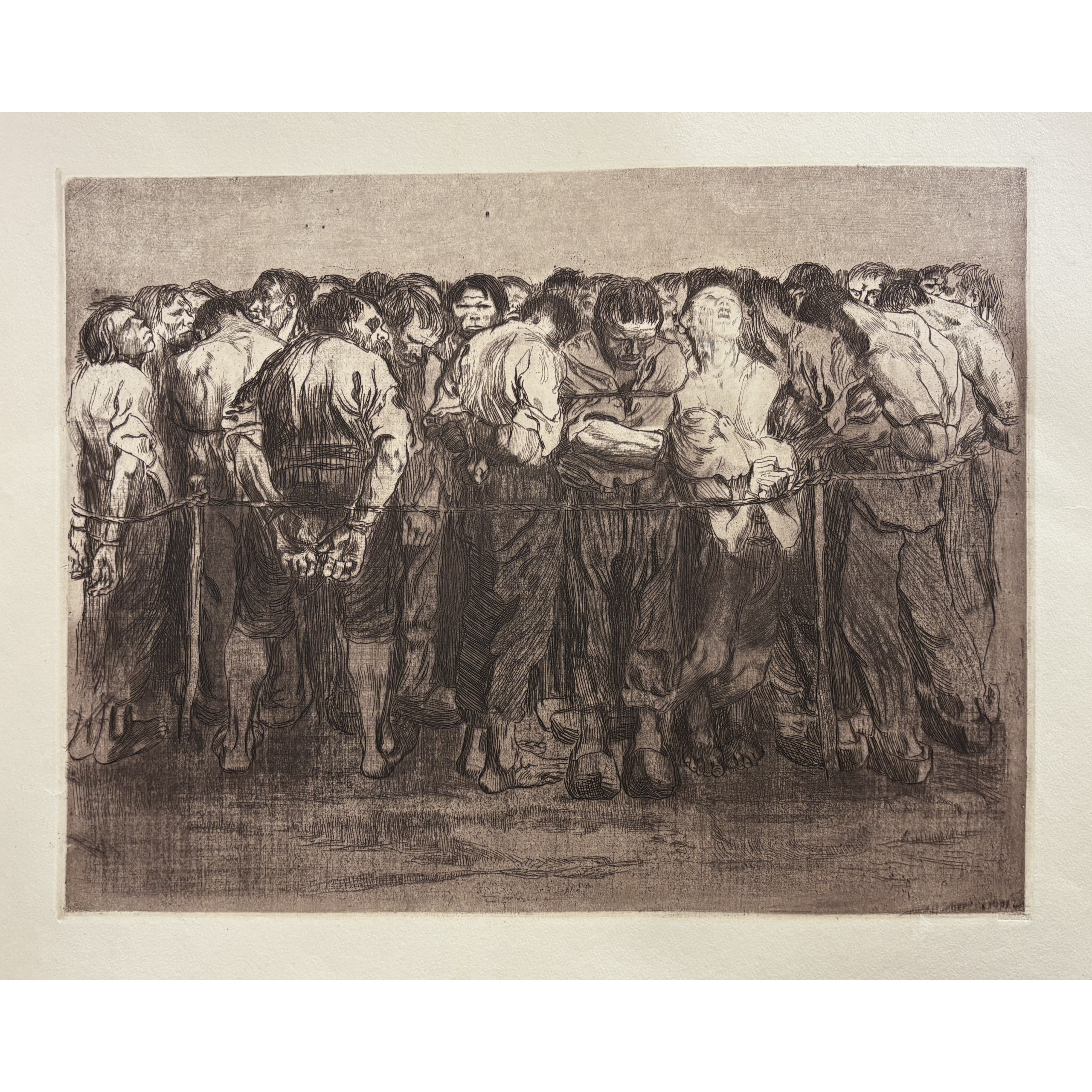
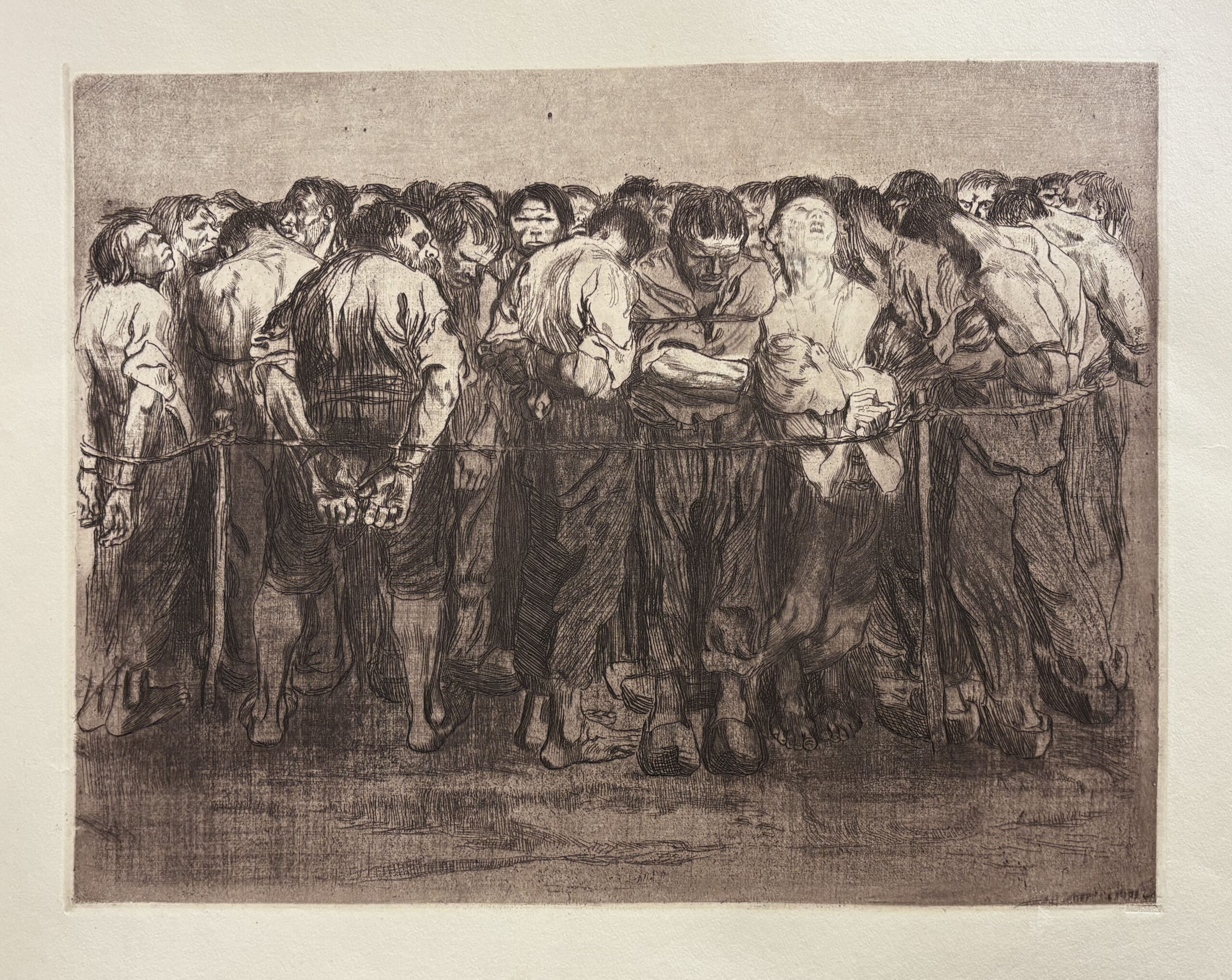
Line etching, drypoint, sandpaper and soft ground with imprint of fabric, printed in brown-black ink with uniform plate tone on heavy, felt-finish, cream wove paper, 17 X 21 inch sheet. Issued by Von der Becke after 1945, with his Munchen 22 drystamp in the lower right corner.
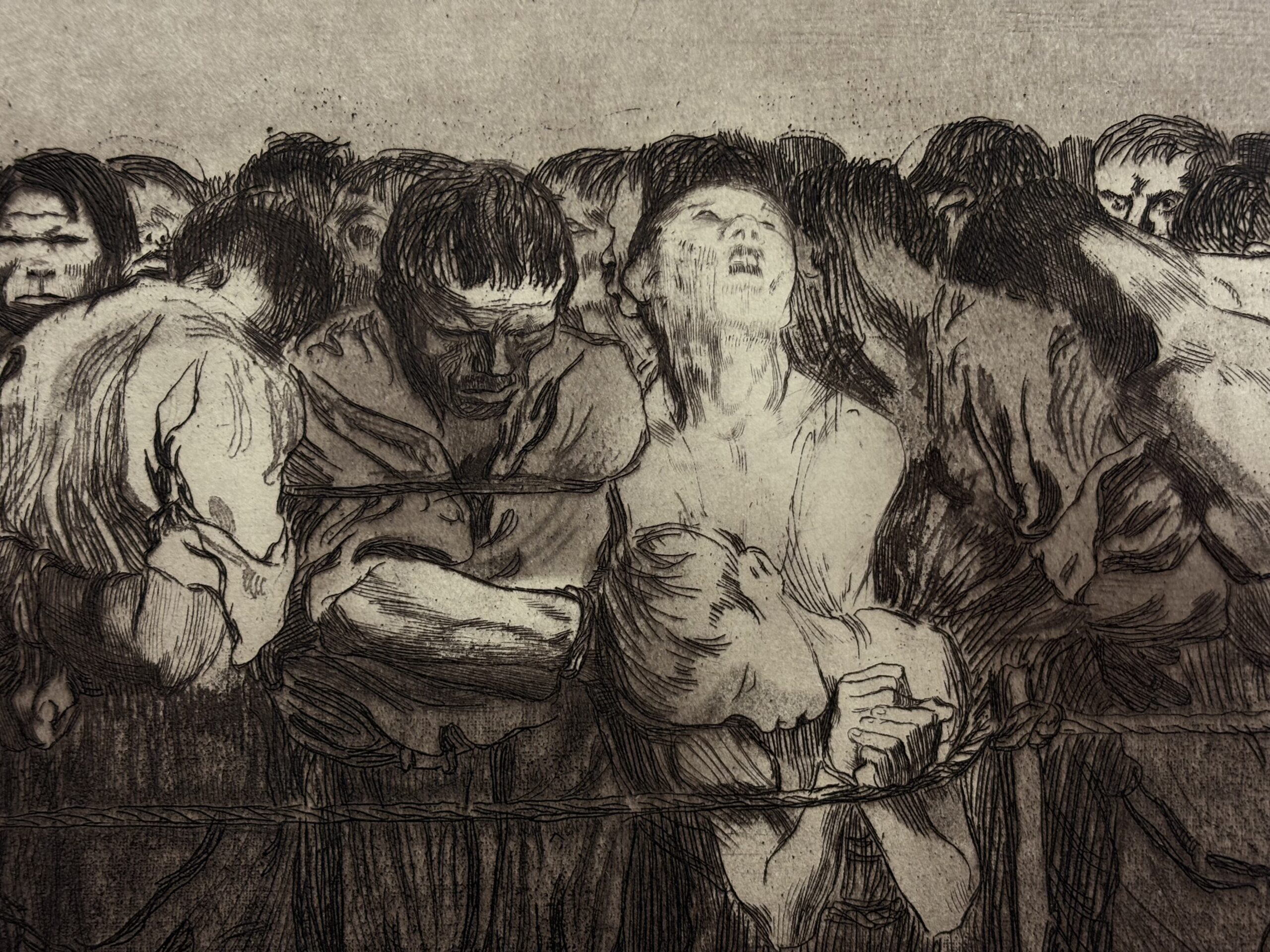
This last motif in the cycle had not been included in the original plan, which was to complete the narrative with the scene of mourning for the fallen men. Eventually, however, Kollwitz decided to choose the image of the captured, yet surviving peasants as the final sheet. She evidently wanted to point out that the conflict is not over and rebellion may break out again at any time. This is probably the intended message of the pair of eyes – just to the left of the central axis in the second row – giving the observer a black look from under knitted brows.
Both sheets 6 and 7 of the etching cycle »Peasants’ War« contain pictorial elements from the originally planned, symbolical final sheet of »A Weavers’ Revolt« (»From many wounds you bleed, oh people«). This sheet also contains figures of captives – bound female figures – as well as a stooping figure reaching out to touch a dead body, as in the »Battlefield« folio. This makes it clear that the »Peasants’ War« cycle, too, presents the conclusion of the events in a two-sheet format. The artist intended to convey a similar message and evidently wanted to emphasize that it is imperative to make sure that social justice is ensured to avoid another outbreak of violence.
Accession Number372208
NotesKollwitz was born in Königsberg, Prussia, the fifth child in her family. Her father, Karl Schmidt, was a radical Social democrat who became a mason and house builder. Her mother, Katherina Schmidt, was the daughter of Julius Rupp, a Lutheran pastor who was expelled from the official Evangelical State Church and founded an independent congregation. Her education was greatly influenced by her grandfather's lessons in religion and socialism.
Recognizing her talent, Kollwitz's father arranged for her to begin lessons in drawing and copying plaster casts when she was twelve. At sixteen she began making drawings of working people, the sailors and peasants she saw in her father's offices. Wishing to continue her studies at a time when no colleges or academies were open to young women, Kollwitz enrolled in an art school for women in Berlin. There she studied with Karl Stauffer-Bern, a friend of the artist Max Klinger. The etchings of Klinger, their technique and social concerns, were an inspiration to Kollwitz.
At the age of seventeen, Kollwitz became engaged to Karl Kollwitz, a medical student. In 1888, she went to Munich to study at the Women's Art School, where she realized her strength was not as a painter, but a draughtsman. In 1890, she returned to Königsberg, rented her first studio, and continued to draw pained labourers working.
In 1891, Kollwitz married Karl, by this time a doctor, who tended to the poor in Berlin, where the couple moved into the large apartment that would be Kollwitz's home until it was destroyed in World War II. The proximity of her husband's practice proved invaluable:
"The motifs I was able to select from this milieu (the workers' lives) offered me, in a simple and forthright way, what I discovered to be beautiful.... People from the bourgeois sphere were altogether without appeal or interest. All middle-class life seemed pedantic to me. On the other hand, I felt the proletariat had guts. It was not until much later...when I got to know the women who would come to my husband for help, and incidentally also to me, that I was powerfully moved by the fate of the proletariat and everything connected with its way of life.... But what I would like to emphasize once more is that compassion and commiseration were at first of very little importance in attracting me to the representation of proletarian life; what mattered was simply that I found it beautiful."
(source: wikipedia.org)
| Artist | Kollwitz |
|---|---|
| Nationality | German |
| Category | German Expressionist, European |