
Additional information
| Artist | Dali |
|---|---|
| Nationality | Spanish |
| Category | European |



ArtistDali, Salvador
Artist Years1904-1989
Artist NationalitySpanish
Year1968
MediumSculpture > Bronze
Dimensions38 X 20 X 12 inches
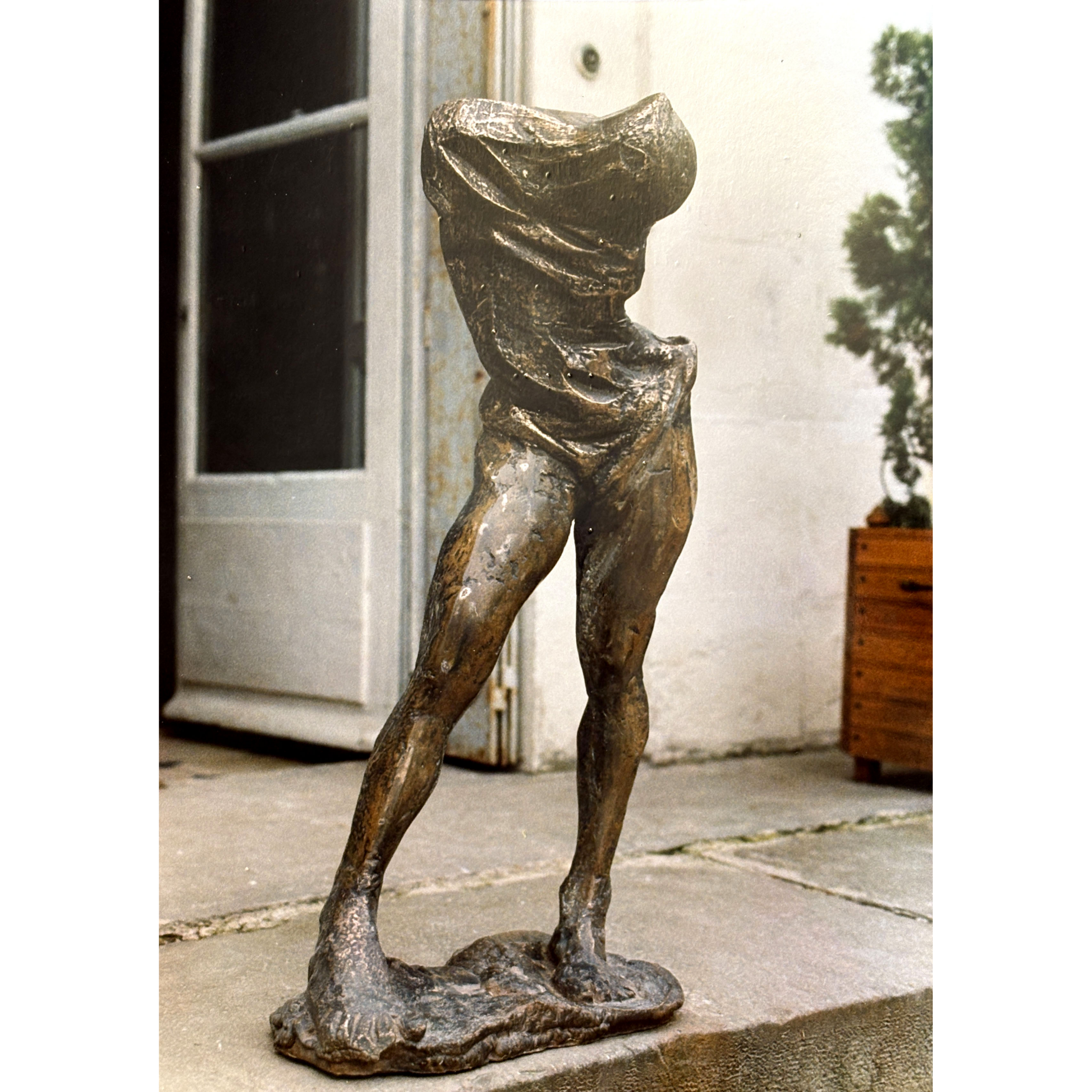
Unique, unsigned, bronze cast.
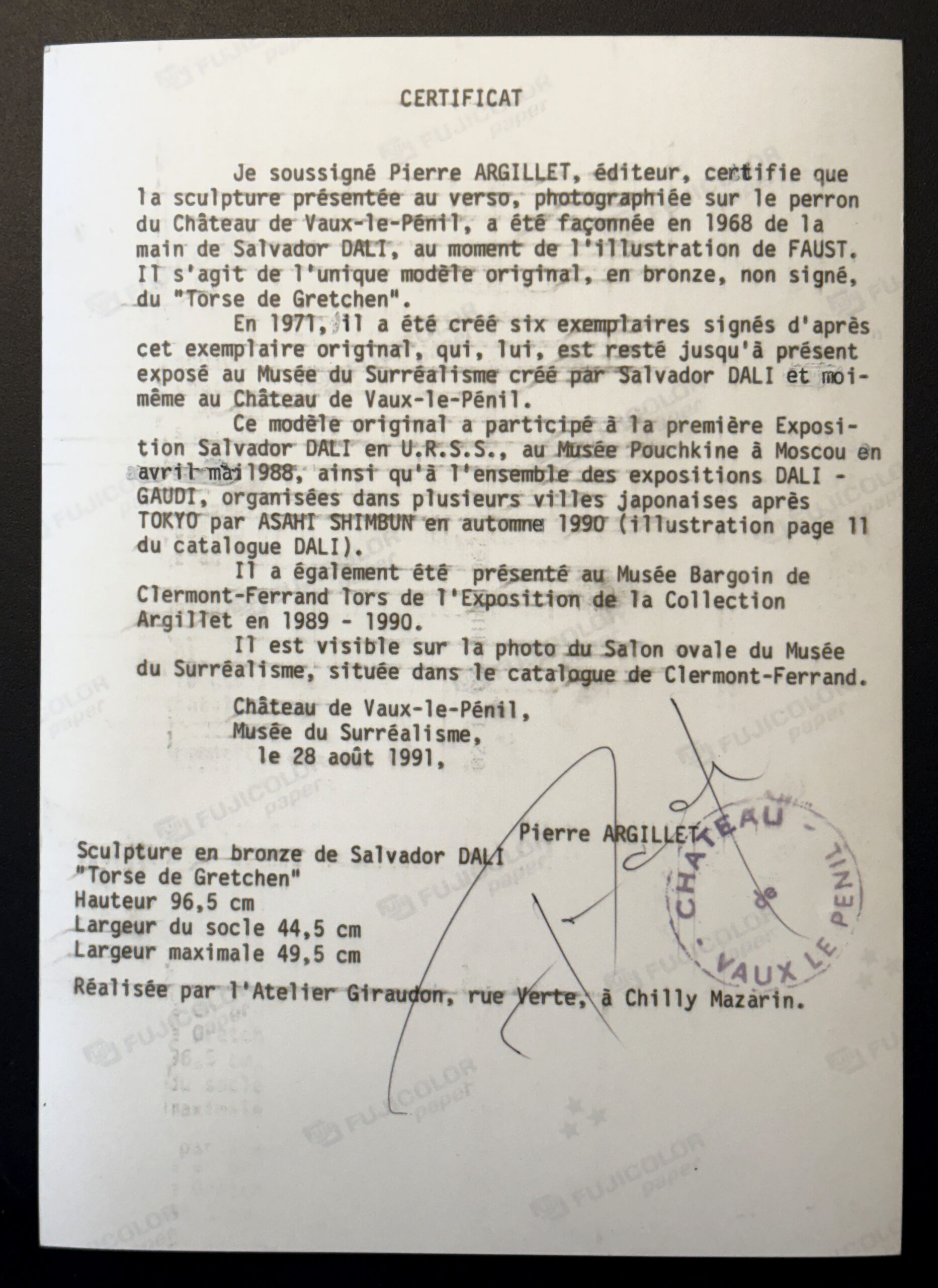
According to Argillet, this work was created by Salvador Dali in 1968, during the period when the illustrations for “Faust” were being drawn. This figure appears in one of the images for the suite titled The Bust (last image here) This is a unique, original prototype without a signature. In 1971, based on this original, six signed copies were produced and are in the collection of the Chateau de Vaux-le-Peril, southeast of Paris. The photos were taken on the steps of the Chateau de Vaux-le-Penil, in 1991.
This original model was exhibited in the first Soviet Salvador Dali exhibition held at the Pushkin Museum of Art in Moscow from April to May 1988, and in the fall of 1990 in all Dali Gaudi exhibitions held by Asahi Shimbun in Tokyo and in several Japanese cities following, The work was also exhibited at the Musee Bargoin in Clermont-Ferrand from 1989 to 1990, and at Musee des Beaux-Arts de Chateau d’Aisace, August 28, 1991.
Accession NumberRC2151
NotesSalvador Dalí was born on 11 May 1904, at 8:45 am GMT, on the first floor of Carrer Monturiol, 20 (presently 6), in the town of Figueres, in the Empordà region, close to the French border in Catalonia, Spain. Dalí's older brother, who had also been named Salvador (born 12 October 1901), had died of gastroenteritis nine months earlier, on 1 August 1903. His father, Salvador Rafael Aniceto Dalí Cusí (1872–1950) was a middle-class lawyer and notary, an anti-clerical atheist and Catalan federalist, whose strict disciplinary approach was tempered by his wife, Felipa Domènech Ferrés (1874–1921), who encouraged her son's artistic endeavors. In the summer of 1912, the family moved to the top floor of Carrer Monturiol 24 (presently 10).
As a child Dalí was taken to his brother's grave and told by his parents that he was his brother's reincarnation, a concept which he came to believe. Of his brother, Dalí said, "[we] resembled each other like two drops of water, but we had different reflections." He "was probably a first version of myself but conceived too much in the absolute." Images of his long-dead brother would reappear embedded in his later works, including Portrait of My Dead Brother (1963).
Dalí also had a sister, Anna Maria, who was three years younger. In 1949, she published a book about her brother, Dalí as Seen by His Sister.
His childhood friends included future FC Barcelona footballers Sagibarba and Josep Samitier. During holidays at the Catalan resort of Cadaqués, the trio played football together.[citation needed]
Dalí attended drawing school. In 1916, he also discovered modern painting on a summer vacation trip to Cadaqués with the family of Ramon Pichot, a local artist who made regular trips to Paris. The next year, Dalí's father organized an exhibition of his charcoal drawings in their family home. He had his first public exhibition at the Municipal Theatre in Figueres in 1918,[22] a site he would return to decades later.
On 6 February 1921, Dalí's mother died of uterus cancer. Dalí was 16 years old; he later said his mother's death "was the greatest blow I had experienced in my life. I worshipped her... I could not resign myself to the loss of a being on whom I counted to make invisible the unavoidable blemishes of my soul." After her death, Dalí's father married his deceased wife's sister. Dalí did not resent this marriage, because he had great love and respect for his aunt.
(source: wikipedia.org)
| Artist | Dali |
|---|---|
| Nationality | Spanish |
| Category | European |