

Additional information
| Artist | Viegener |
|---|---|
| Nationality | German |
| Category | German Expressionist, European |
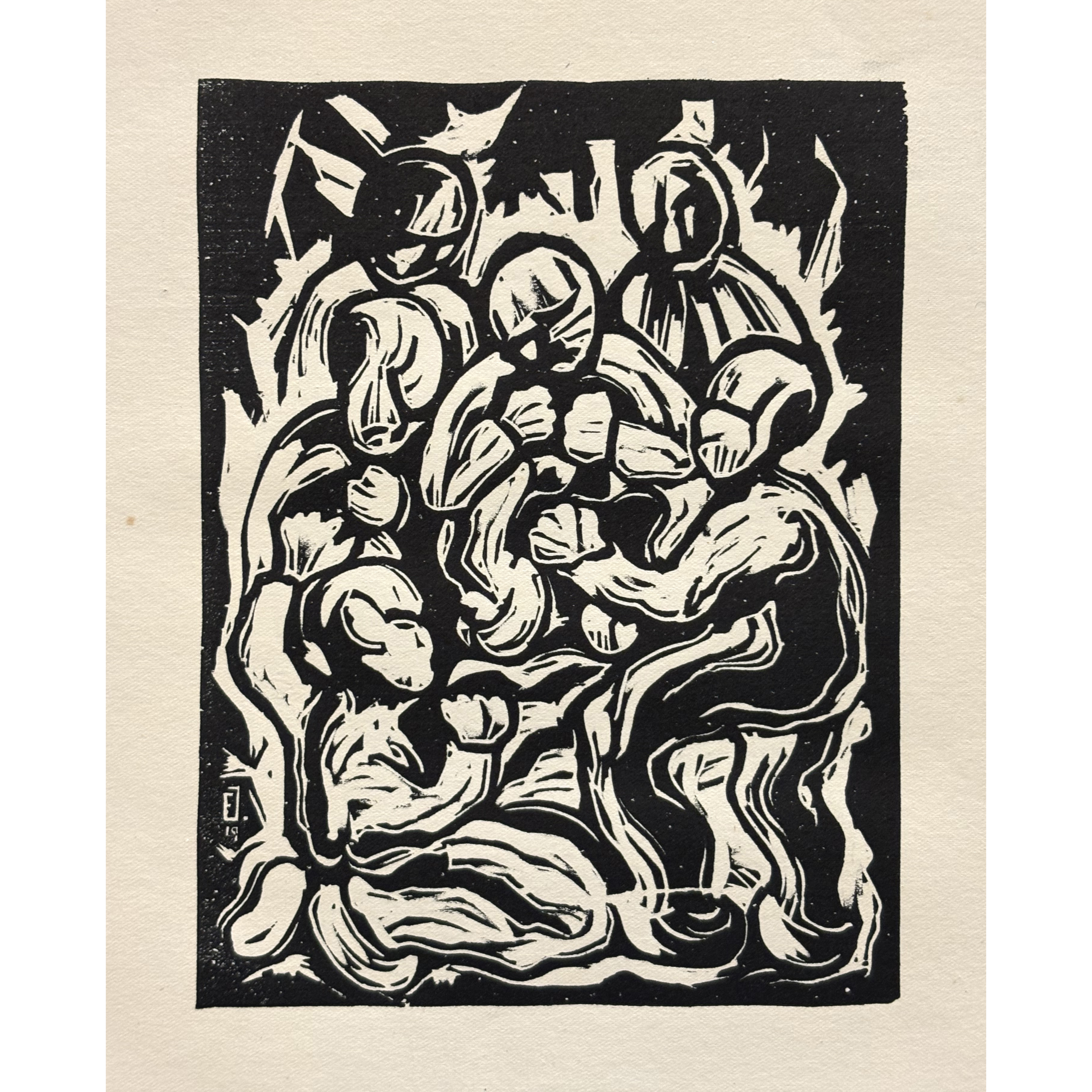
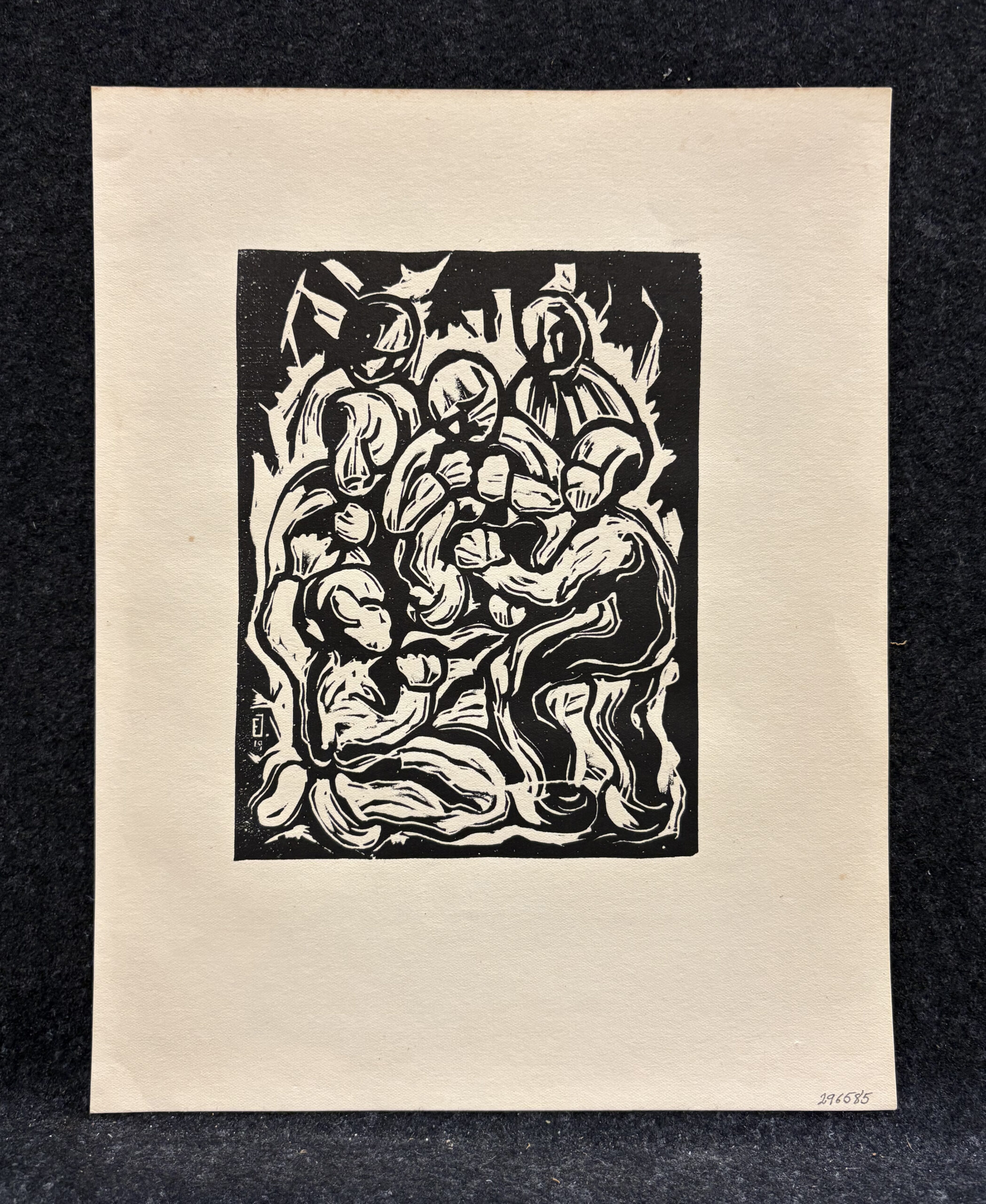
ArtistViegener, Eberhard
Artist Years1890-1967
Artist NationalityGerman
Year1919
MediumPrint > Woodcut
DimensionsComposition: 6.6 X 5 inches
Sheet: 11 X 8.6 inches
Catalog ReferenceRifkind 3048
Original woodcut, sometimes titled Conversation, signed with the monogram and dated “19” in the block, printed on fine-grained, cream wove paper. Published in Das Kestnerbuch, Paul E. Kuppers ed., Heinrich Bohme Verlag, Hannover, 1919.
Accession Number296585
NotesEberhard Viegener (b. May 1890 in Soest ; † 4. May 1967 in Bilme) was a German expressionist and representative of the New Objectivity as well as a decorative and landscape painter.
Viegener completed a painting apprenticeship in his father’s company from 1904 to 1906 after school. In 1907 he spent a year of teaching in Hagen, and used his time for studies in the Folkwang Museum. From 1908 to 1912 he worked in his father's painting business, from 1912 to 1913 he was a painter in Zurich. From 1913 to 1914 he was a self-taught artist in Klosters. Since 1920 he lived in Bilme near Soest.
In 1914 he returned to Soest with about 25 small-format pictures. With the artists Arnold Topp, Wilhelm Morgner and Wilhelm Wulff, Viegener was friendly and influenced by their painting style. He was not drafted for war service because of weak health. In 1916 he had his first exhibition participation in the jury-free.
In 1919 he got a contract with the Düsseldorf gallery owner Alfred Flechtheim, to whom he had his first exhibition from September to October 1919. As a result, the graphic folders were created: Passion, Death Dance, The Moon over Soest, Sauerland, as well as numerous individual sheets.
In 1920, he married former actress Cäcilie Brie, who was married to Paul Henckels in her first marriage. She was the daughter of state law expert Siegfried Brie. The couple had three children; Felix (also called Tobias), Vincent, and Amanda.
Viegener participated in exhibitions in Münster, Recklinghausen, Barmen and Bochum. From 1927 to 1930 he participated in the jury-free art exhibition in Berlin. In 1934 he founded the Eberhard-Viegener-Gesellschaft in Dortmund.
Viegner was friends with the painter and graphic artist Bruno Beye. Already at the beginning of the 1930s, Viegener changed his style and painted realistic landscapes.
During the time of National Socialism, Viegener was a compulsory member of the Imperial Chamber of Fine Arts. For this time, his participation in 11 exhibitions is safely documented, including 1936 in Essen Westfront 1936. Free art in the new state, which was close to the National Socialist ideology. However, his expressionist works were considered entartet"degenerate" to the Nazis, and in 1937, as part of the concerted campaign "Degenerate Art" in Germany, a significant number of them from the National Gallery (Kronprinzen-Palais) and the Kupferstichkabinett Berlin, the Städtische Kunsthaus Bielefeld, the Städtische Gemäldegalerie Bochum, the Städtische Kunst- und Gewerbemuseum Dortmund, the Museum of Art and Local HistoryMuseum FolkwangUniversität GöttingenHagenProvinzial-Museum HannoverLandesmuseum MünsterSoestRuhmeshalle[3] Regardless, he was able to continue to present his new works at exhibitions.
From 1945 to 1966 he participated in more than fifty solo and group exhibitions. In 1946, together with Herta Hesse and Wilhelm Wessel, he founded the West German Artists’ Association, an association of painters, graphic artists, sculptors, photographers and media artists in North Rhine-Westphalia, whose chairman was from 1947. In 1951/1952, he belonged to the Fritz Dähnboard of the jury of the all-German art exhibition Artists for Peace in East Berlin.
In 1954 he married Annemarie Mehlhemmer (1916–2003), who was also a painter under the name Annemarie Viegener.[ He was the brother of the painter and sculptor Fritz Viegener and the Hamm/Westphalian photographer Joseph Viegener.
(source: wikipedia.org)
| Artist | Viegener |
|---|---|
| Nationality | German |
| Category | German Expressionist, European |