

Additional information
| Artist | Aleksandrov |
|---|---|
| Country | American, Lithuanian |
| Region | Soviet / CIS |

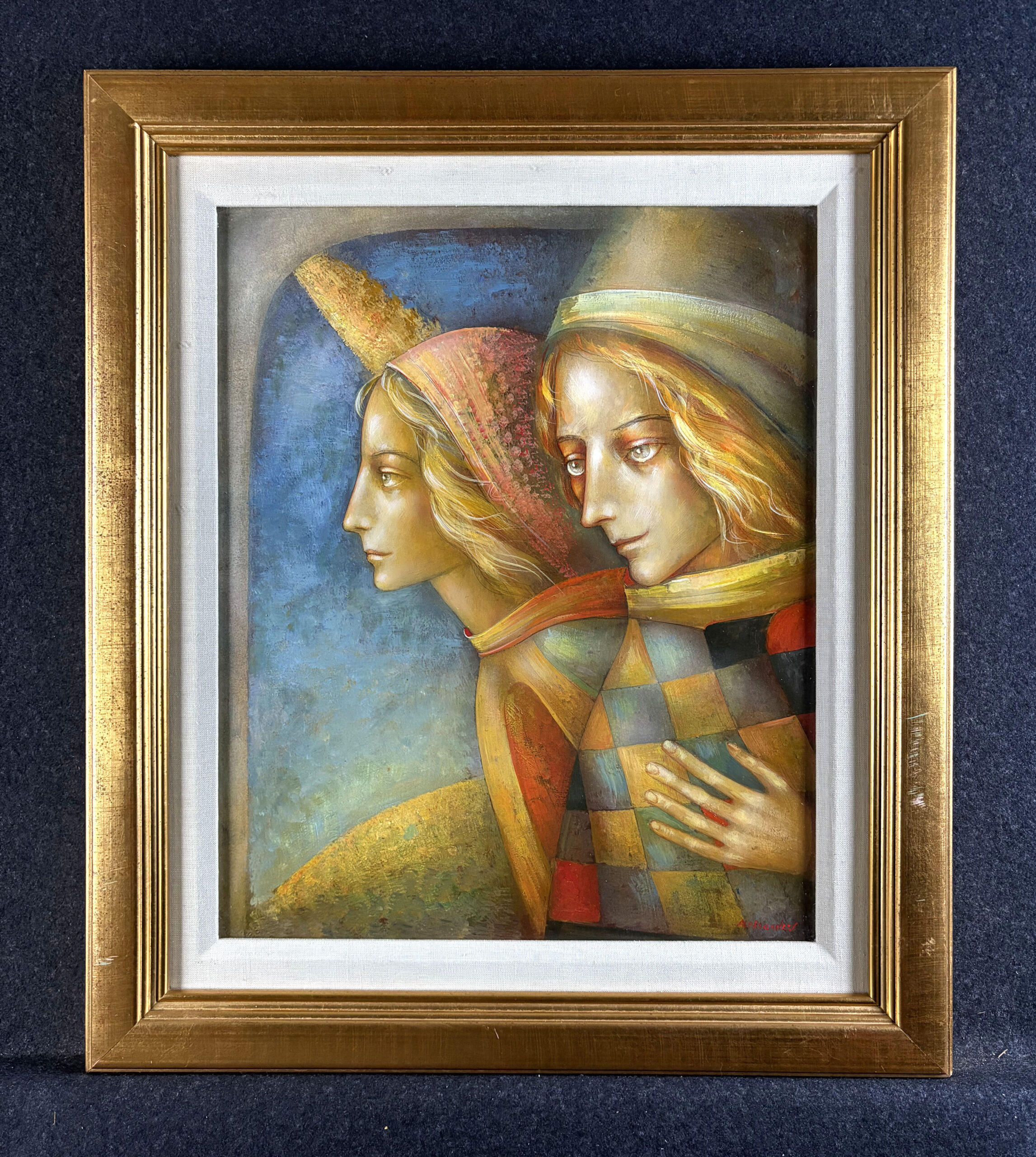


ArtistAleksandrov, Mihail
Artist Years1949-living
Artist NationalityAmerican, Lithuanian
Yearca. 1970
MediumPainting > Oil
DimensionsCanvas: 17 X 14 inches
Oil on canvas, signed lower right.
Accession NumberRC2062
Notes Mihail Aleksandrov, born June 2, 1949, is a Lithuanian-born painter known for his highly-developed, mythological renderings of iconic and spiritual themes. His work is collected in more than 20 countries. Although he was born in Lithuania, Aleksandrov is considered part of the Russian tradition as his painting style is deeply rooted in the Russian spiritual and artistic tradition.
Aleksandrov was born in Vilnius, Lithuania. His parents were Boris and Anna Aleksandrov who had left Moscow for Vilnius after World War II. His father was as a research geologist; his mother taught history at a local college, and he has an older brother Vladimir. Aleksandrov had a happy childhood in a suburb of Vilnius abundant with forests and rivers. As a boy he was intrigued by the Baroque and Gothic architecture of Vilnius. At the age of 12 he attended the Vilnius Art School and did so for five years. At 17 he went to the Vilnius Art Academy, but his style did not conform to the rigid Soviet norms. He transferred and studied at the Vilnius Pedagogical Institute to study Russian History and Literature, earning a degree in Russian Language and Literature in 1971.
During this time, like many Russian artists under the Soviet regime, he had trouble following his aspirations in his homeland, and he continued to pursue being an artist without official sanction of the state. Aleksandrov was in the service of the Soviet Army for a year and then moved to Tallinn, Estonia where he participated in several exhibitions of "unofficial" art. During this period he began to perfect his highly individualistic manner of painting using forms and colors that transcend the physical into the spiritual. Alexsandrov taught Art Technique for five years. During this time he continued to produce artwork, but it was not until 1978 that he began selling his paintings.
The late seventies and early eighties marked the beginning of a new era for a generation of Soviet contemporary artists. Aleksandrov was at the forefront of a group of artists that were finally permitted to exit the USSR and emigrate to the West, but not without some challenges. "The Soviet Union wasn't easy to leave. Authorities tried to discourage me and scare me. It took one and a half years from the time I applied for permission before I could leave." It was also at this time when the auction houses began to include these artists in their auctions and a few avant-garde galleries held exhibitions to introduce this new art to the West. In 1979 he applied for an emigration visa and in 1980 moved to Los Angeles under a grant from the Tolstoy Foundation. He exhibited his work on the West Coast for a year and then relocated to New York in 1981. He became an American citizen in 1987.
Aleksandrov has been married twice: His first wife Svetlana Startseva (1970-1979) now lives in Moscow. His second wife Elena, whom he met in New York city and married in 1986, is his muse and inspiration. She used to work in the medical field and loves sport and modern dance. He often uses Elena's face as inspiration. "Her face is a window to a better world," he has explained. Her face appears very clearly in a work called Godiva.
During his fourth-year of art school in Vilnius, Aleksandrov had read scholar John Rewald's writings on Post Impressionism, and this reading was a major inspiration to pursue an art career.
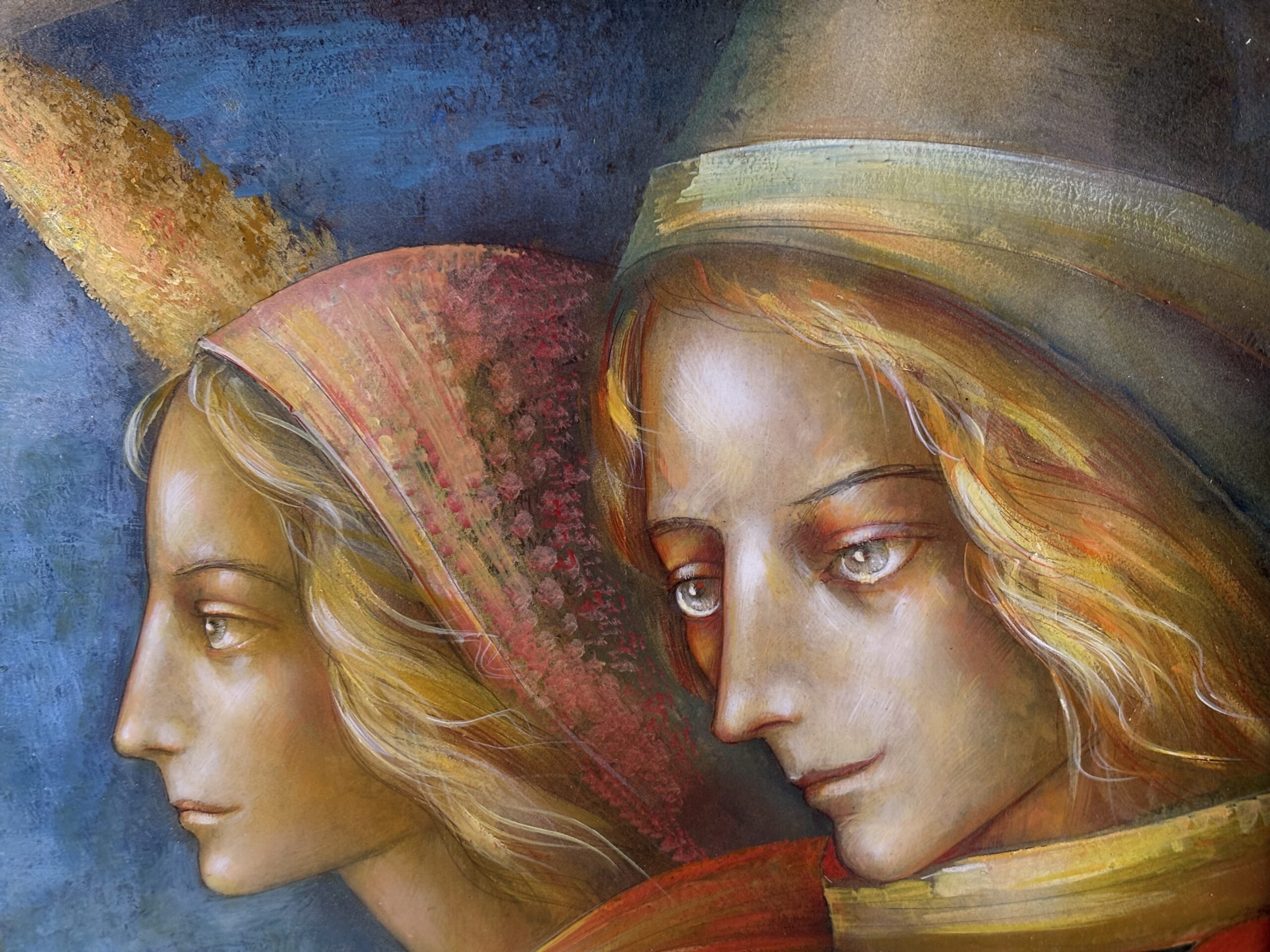
Aleksandrov works primarily in oil, watercolor and tempura. He uses a lot of reds and greens in his works, but golden color is prevailing. His dislike of "trendy art" has taken him to the past for inspiration; thus a late-medieval, early-Renaissance style is evidenced in his painting.
He is a Christian and his paintings contain hints of the spiritual beliefs of his homeland. He integrates geometric forms with the human body and has an intense familiarity with icon painting as an artistic and religious form. "The people in my paintings mostly represent human souls, spiritual being, philosophy of life, some archetypes, but not physical bodies."
While he is also interested in the mysticism and scholasticism of medieval Western Europe, this interest is mainly on the level of theological schemes and interpretations. He finds the art of the Italian Renaissance deeply moving, and not merely in terms of its plastic form. In certain respects he is close to the dramatic tension of Mannerism. Themes such as beauty, perfection, spirituality and revelations play an integral part of his artistic conception.
Aleksandrov's Approach to Painting
Having been formally educated in Language and Literature, Aleksandrov has often claimed that poetry is essential for his art, and that Russian poetry has had a greater influence on him than Russian painting. "Poetry is at the heart of all arts, including prose, painting and music. The lyrical strain leads me from era to era, where I seek, in the various times and styles, whatever it is I need to make a poetic image materialize."
In his biography, Aleksandrov commented: "Spirituality is my transformation, my aspiration to grow. As artists we need a transformational touch of the spiritual world. It transforms our tireless labors into something beautiful and everlasting. Symbolism is vitally important in my art. Symbols define the inexpressible. This inexpressible is the object of my art. Art represents man. The intricacies of a man's life during his most complex and decisive moments can only be expressed by a symbol. Hence, symbolism in art has a unifying, elevating importance. A man does not live a life of harmony without unity of all his orders; physical, emotional, intellectual and spiritual."
Aleksandrov, in an interview with Alexandre Gertsman, explained that he is always learning, which is the best position for an artist to take—never to consider himself a master, or to even believe that he has accomplished anything, but to always be a student. He is quoted as saying that his later works are more important to him as an artist who "lives in the future."
(Source: John Rewald, Wikipedia.org)
| Artist | Aleksandrov |
|---|---|
| Country | American, Lithuanian |
| Region | Soviet / CIS |