

Additional information
| Artist | Singer |
|---|---|
| Nationality | Austrian, Czech |
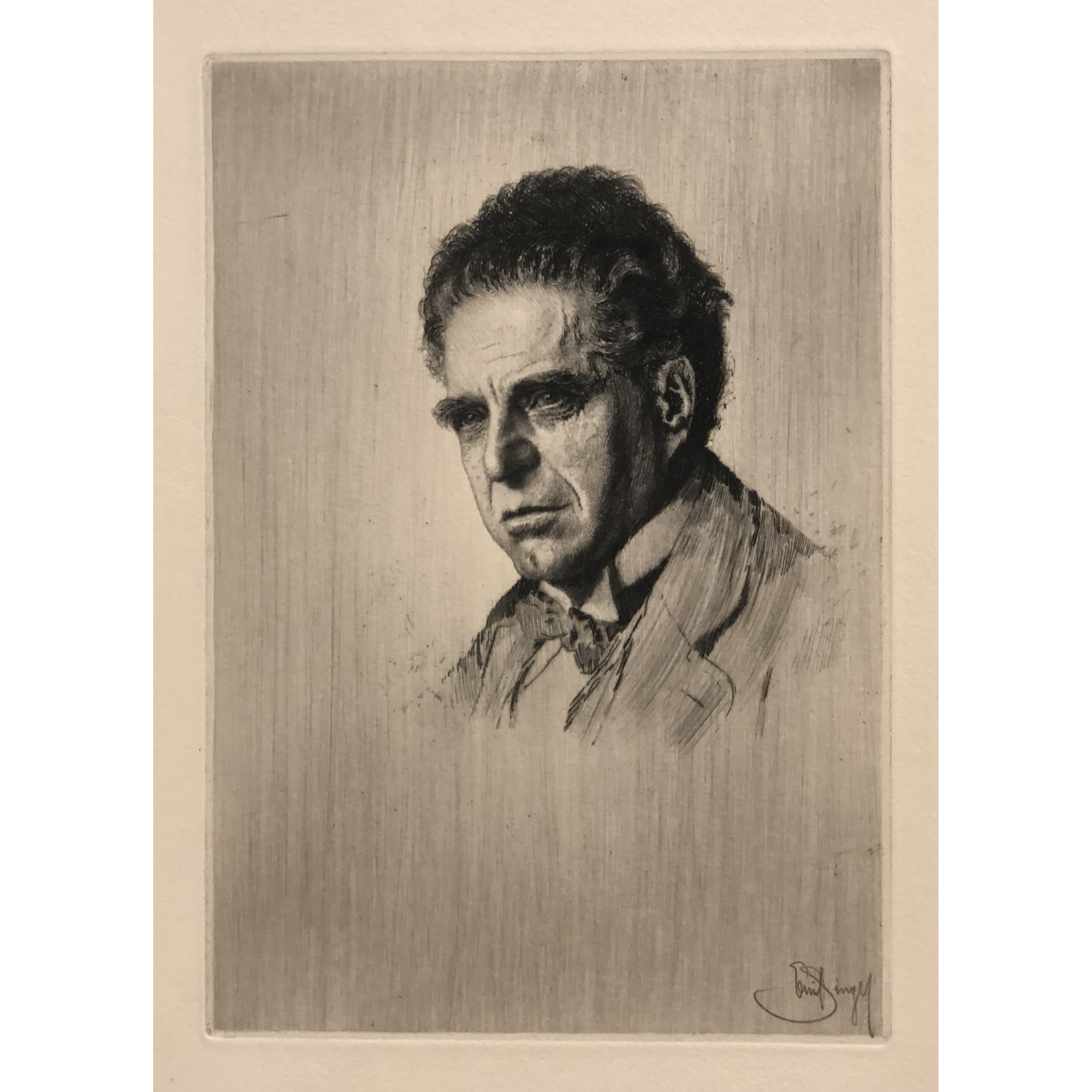
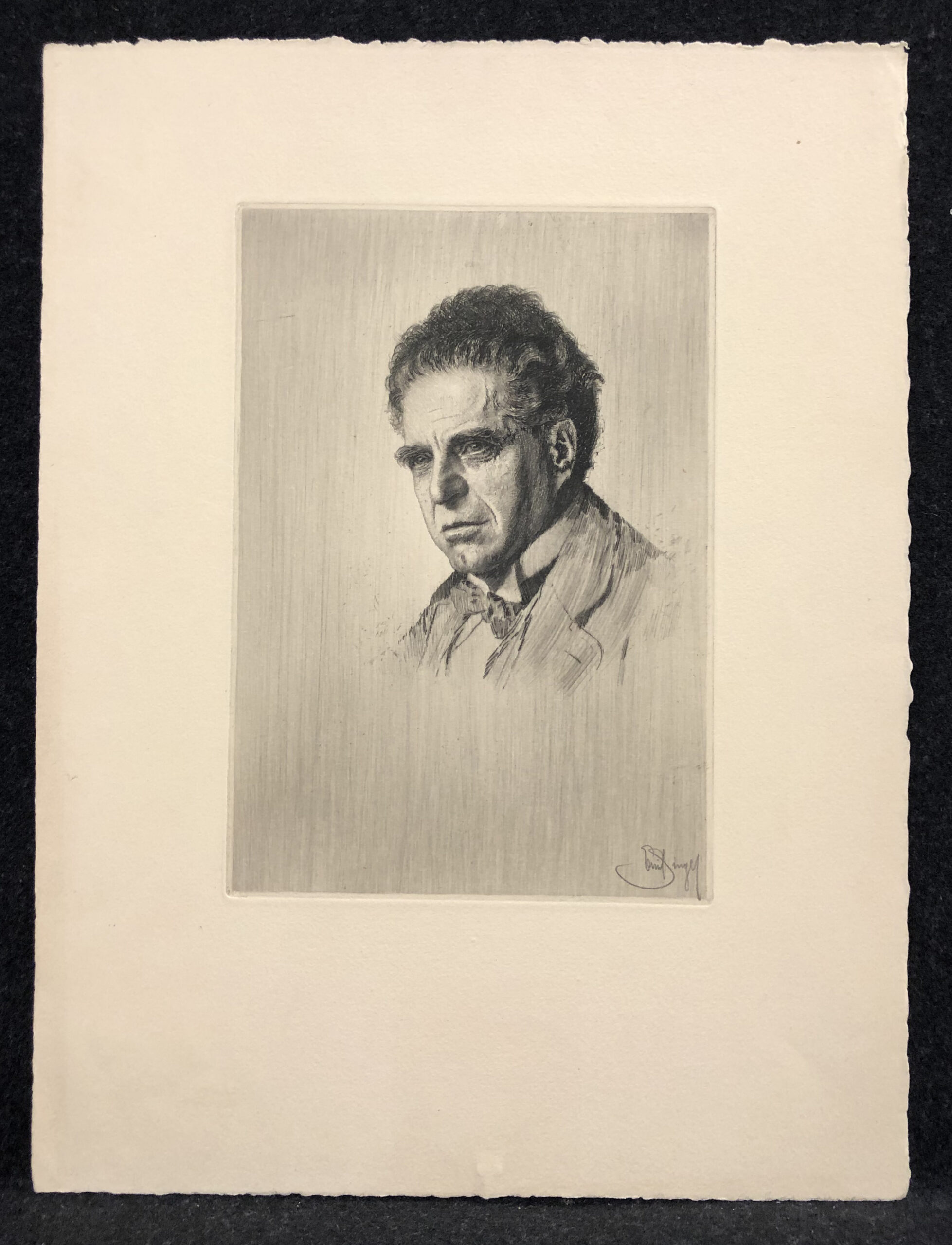
ArtistSinger, Emil
Artist Years1885-1942
Artist NationalityAustrian, Czech
Year1925
MediumPrint > Etching
DimensionsPlate: 9.7 X 6.8 inches
Sheet: 16 X 12 inches
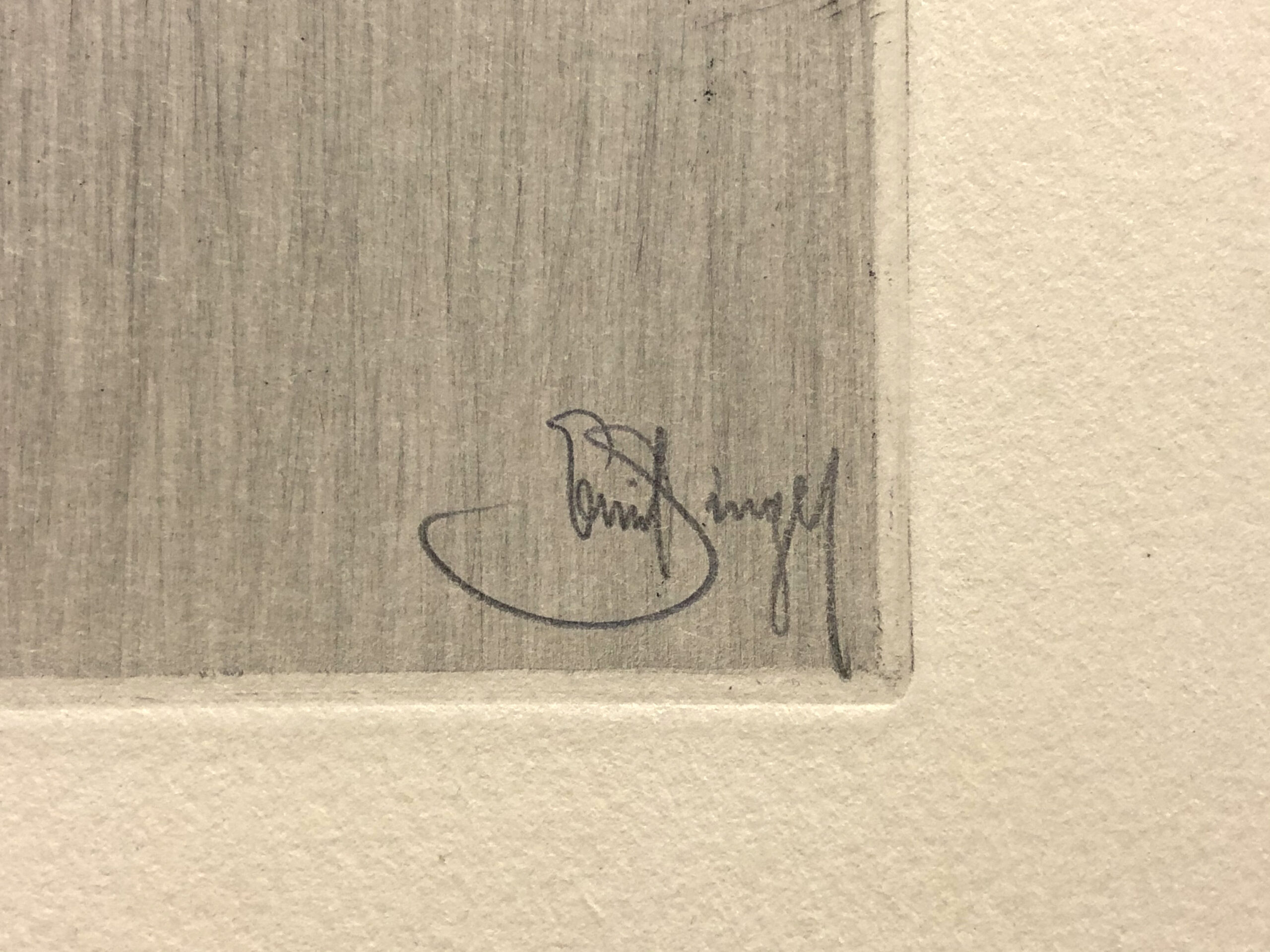
Original etching, signed in pencil in the image lower right corner, printed on heavy, felt-finish, cream wove paper.
NotesEmil Singer was born in Moravia (now Czech republic). He grew up with his younger sister Ella in a Jewish family of craftsmen. The father Wilhelm Singer was a master saddler and upholsterer. In 1891 he moved to Brno with the von Gaya (now Kyjov) family and opened a saddlery and upholstery workshop. Emil attended the three-year community schooland the two-year Gremial Business School, where he received a commercial training. At the age of 16 he worked in the Siegmund Fluss dye works, whose factory was on line 38 across from the Singer family's apartment on line 29. Like his father Wilhelm Singer, Fluss was a craftsman and a Jew. He had several branches, one of them in Vienna, where Emil could work when he moved to Vienna, not yet of legal age. There he attended the private art school Streblow in Annagasse for a year and from the winter semester 1902/03 to the summer semester 1906 the graphic teaching and research institute, Section I for photography and reproduction processes. In the courses he worked with Otto Trauner and at times with Gustav Böhm and Luigi Kasimirtogether. Some of his first pictures were displayed in shop windows in Brno. In 1904 his lithograph of a nude picture was included in a collection of the best term papers at the Graphic Education and Research Institute. In 1906 his professor Arthur Wilhelm Unger reproduced two lithographs of him in his standard work “The Production of Books”.
After completing his training, Singer worked from 1906 to around 1915 as a photogravure technician at the Patzelt & Co. art institute on Lerchenfelderstrasse. In December 1908 he married Grete Manuel and moved to Lerchenfelderstrasse 135, where he lived with his wife for over three decades across from or next to the Patzelt Art Institute. In 1910 he exhibited his first etching “Der Krautmarkt in Brünn” in the Vienna Künstlerhaus, followed in 1911 by the “Brno Vegetable Stalls” and the “Dominican Ramp in Brno”, in 1912 by “St. Peter's Basilica in Brno” and “At Dawn (Brno Krautmarkt)”. From 1913 he created etchings with WienerMotifs. He exhibited his works first in the Vienna Künstlerhaus, then in the Brno Künstlerhaus. He created eleven large-format etchings with five motifs each from Brno and Vienna and one motif from Prague. Until around 1920 his motifs were graceful places in Brno and Vienna, from 1923 onwards they were mainly representative buildings and sights in Vienna and Germany. Today his works can be found in 20 museums and collections worldwide. 102 etchings, five oil paintings, three lithographs, two watercolors and seven other works are known.
As early as 1936 he had contacts in the USA and offered etchings with an English title and American dimensions in his price list. Two Americans who visited him in Vienna made closer contact with the USA. Reginald R. Isaacs, who later became the town planner and biographer of Walter Gropius , sold Singer's etchings in the Jewish communities of Minneapolis and St. Paul and sent the proceeds to Vienna. Amos Deinard, a blind lawyer and acquaintance of Isaacs, stood up for the Singer couple among high-ranking personalities, obtained the guarantees and paid for the passage from Lisbon to New York , which was scheduled for March 17, 1941 . With the help of Victor Leffingwell, a doctor in Sharon in Pennsylvania , a circle of friends was established there to support Emil and Grete Singer. Philip Ellovich got the guarantees and the ticket for the passage one more time. Minneapolis and Pennsylvania Senators John S. Alexander and Joseph F. Guffey turned to the American Consul General in Vienna, but received the negative answer that the Singers were too old and had no US relatives to pay for them. Emil and Grete Singer lived for the last eleven months in a room in a collective apartment at Herminengasse 18. On May 12, 1942, the couple were deported to Izbica and there or in the Belzec extermination campmurdered. Singer's younger sister Elvire (Ella) married. Blum lived in Brno and was also a victim of the Holocaust with her family.
After the war, Ellovich asked an American officer in Austria to find out something about the fate of the Singers. Dr. Meznick from the press service of the Federal Chancellery announced that the Singers in Poland “probably found death by gassing”. The Viennese art dealer August Eymer had sold works by Singer and in 1965 told the curator of the Slovenian National Gallery that Emil Singer was facing Nazi persecutionfled to the United States and died in New York. During his denazification, Eymer stated that he had helped a number of Jewish people and kept works of art for them in Vienna. Ed Leffingwell held a commemorative exhibition in Youngstown, Ohio, on the 100th birthday of Emil Singer in 1981; his article on the exhibition and Singer's letters to Ellovich are in the Emil Singer Papers at the Holocaust Museum in Washington . Singer's letters to Reginald Isaacs were from his son Henry Isaacs in the Archives of American Art, Smithsonian Instituteand are in the Reginald Isaacs Papers, Folders Emil Singer. Reginald R. Isaacs donated the Emil Singer Memorial Prize for Graphic Presentation to the students of his department when he started teaching at the School of Design at Harvard in 1954. Images of some of Emil Singer's works are placed online by the Moravian Gallery Brno, the Jewish Museum Prague, the Museum of the City of Bratislava, the British Museum London and the Minnesota Institute of Arts.
(source: wikipedia.org)
| Artist | Singer |
|---|---|
| Nationality | Austrian, Czech |