

Additional information
| Artist | Kollwitz |
|---|---|
| Nationality | German |
| Category | German Expressionist, European |
ArtistKollwitz, Kathe
Artist Years1867-1945
Artist NationalityGerman
Year1897
MediumPrint > Etching
DimensionsPlate: 8.2 X 11.3 inches
Sheet: 12.7 X 9.4 inches
Catalog ReferenceKlipstein 32; von Knesebeck 36
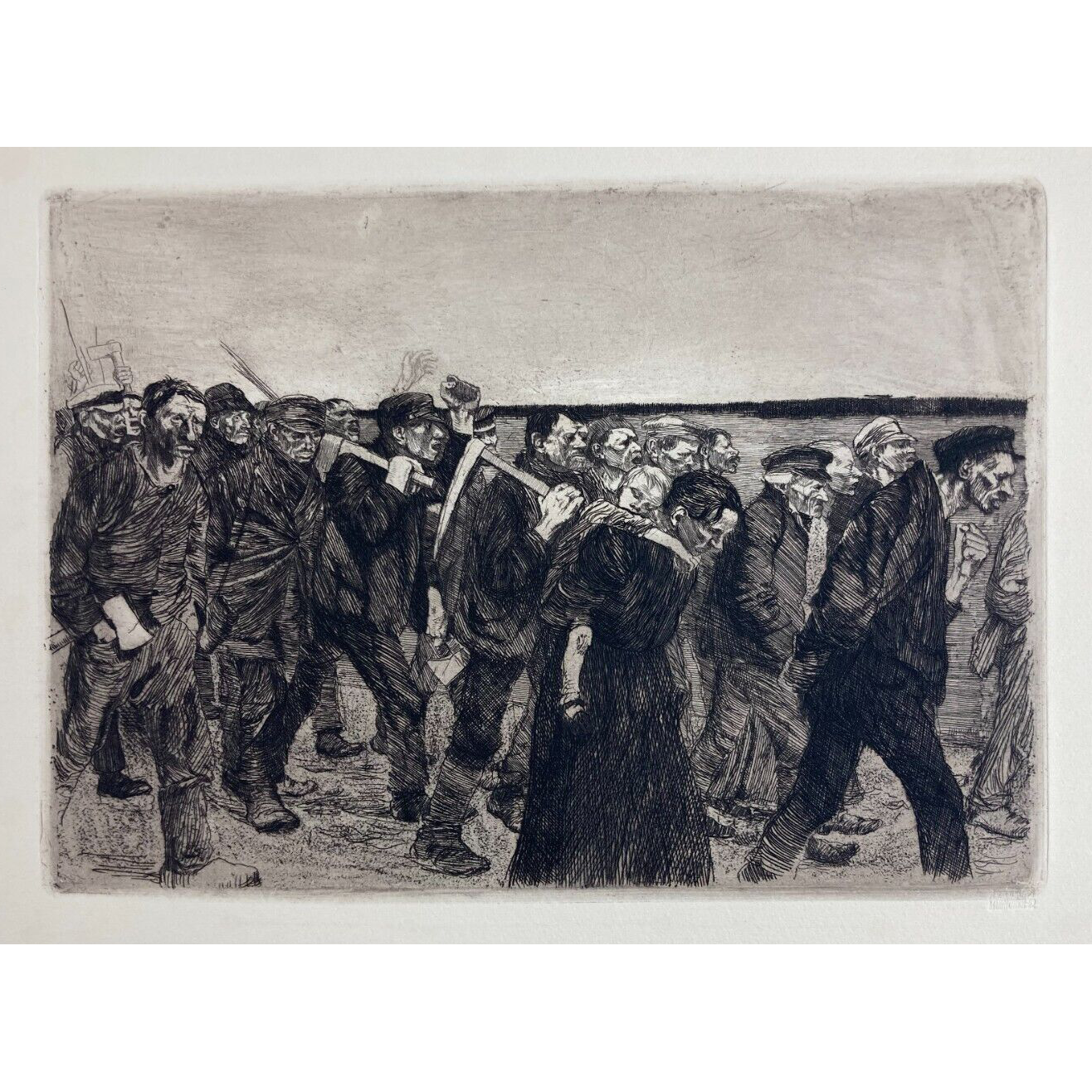
Original etching, Plate 4 of A Weaver’s Revolt, not signed, published by Auguste von der Becke between 1931 and 1946, with the 3-line Berlin-Halensee blindstamp at lower right.
Accession Number512287
Notes1:
Kollwitz was born in Königsberg, Prussia, the fifth child in her family. Her father, Karl Schmidt, was a radical Social democrat who became a mason and house builder. Her mother, Katherina Schmidt, was the daughter of Julius Rupp, a Lutheran pastor who was expelled from the official Evangelical State Church and founded an independent congregation. Her education was greatly influenced by her grandfather's lessons in religion and socialism.
Recognizing her talent, Kollwitz's father arranged for her to begin lessons in drawing and copying plaster casts when she was twelve. At sixteen she began making drawings of working people, the sailors and peasants she saw in her father's offices. Wishing to continue her studies at a time when no colleges or academies were open to young women, Kollwitz enrolled in an art school for women in Berlin. There she studied with Karl Stauffer-Bern, a friend of the artist Max Klinger. The etchings of Klinger, their technique and social concerns, were an inspiration to Kollwitz.
At the age of seventeen, Kollwitz became engaged to Karl Kollwitz, a medical student. In 1888, she went to Munich to study at the Women's Art School, where she realized her strength was not as a painter, but a draughtsman. In 1890, she returned to Königsberg, rented her first studio, and continued to draw pained labourers working.
In 1891, Kollwitz married Karl, by this time a doctor, who tended to the poor in Berlin, where the couple moved into the large apartment that would be Kollwitz's home until it was destroyed in World War II. The proximity of her husband's practice proved invaluable:
"The motifs I was able to select from this milieu (the workers' lives) offered me, in a simple and forthright way, what I discovered to be beautiful.... People from the bourgeois sphere were altogether without appeal or interest. All middle-class life seemed pedantic to me. On the other hand, I felt the proletariat had guts. It was not until much later...when I got to know the women who would come to my husband for help, and incidentally also to me, that I was powerfully moved by the fate of the proletariat and everything connected with its way of life.... But what I would like to emphasize once more is that compassion and commiseration were at first of very little importance in attracting me to the representation of proletarian life; what mattered was simply that I found it beautiful."
(source: wikipedia.org)
2.
March of the Weavers is the fourth plate of six in a series Kollwitz called Ein Weberaufstand (The Rise of the Weavers). This series proved to be one of the most important works of her early career, as its public display in Berlin in 1898 catapulted her to national recognition. With the content of The Rise of the Weavers, Kollwitz was responding to a theatrical play by Gerhard Hauptmann, titled The Weavers, which told the story of an 1844 revolt over wages. In her diary, Kollwitz remembers the excitement and inspiration she gleaned from viewing that play, as well as the challenges she faced producing the series:
“A great event took place during this time: the Freie Buehne’s première of Hauptmann’s The Weavers. The performance was given in the morning. I no longer remember who got me a ticket. My husband’s work kept him from going, but I was there, burning with anticipation. The impression the play made was tremendous. The best actors of the day participated, with Else Lehman playing the young weaver’s wife. In the evening there was a large gathering to celebrate, and Hauptmann was hailed as the leader of youth."
| Artist | Kollwitz |
|---|---|
| Nationality | German |
| Category | German Expressionist, European |