

Additional information
| Artist | Breton |
|---|---|
| Nationality | French |
| Category | Barbizon |


ArtistBreton, Jules
Artist Years1827-1906
Artist NationalityFrench
Year1889
MediumPrint > Etching
DimensionsPlate: 17 X 26.6 inches
Sheet: 20.5 X 30 inches
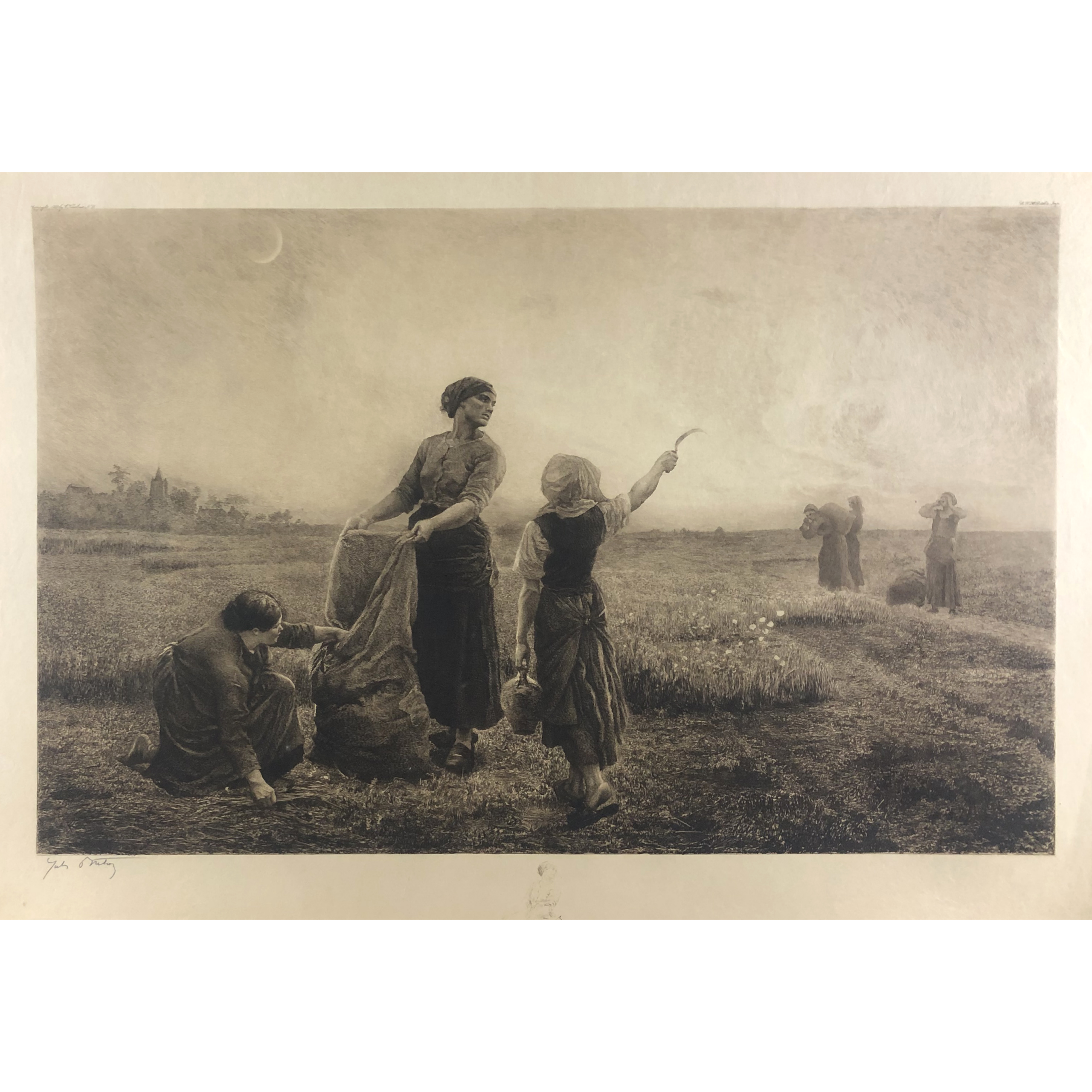
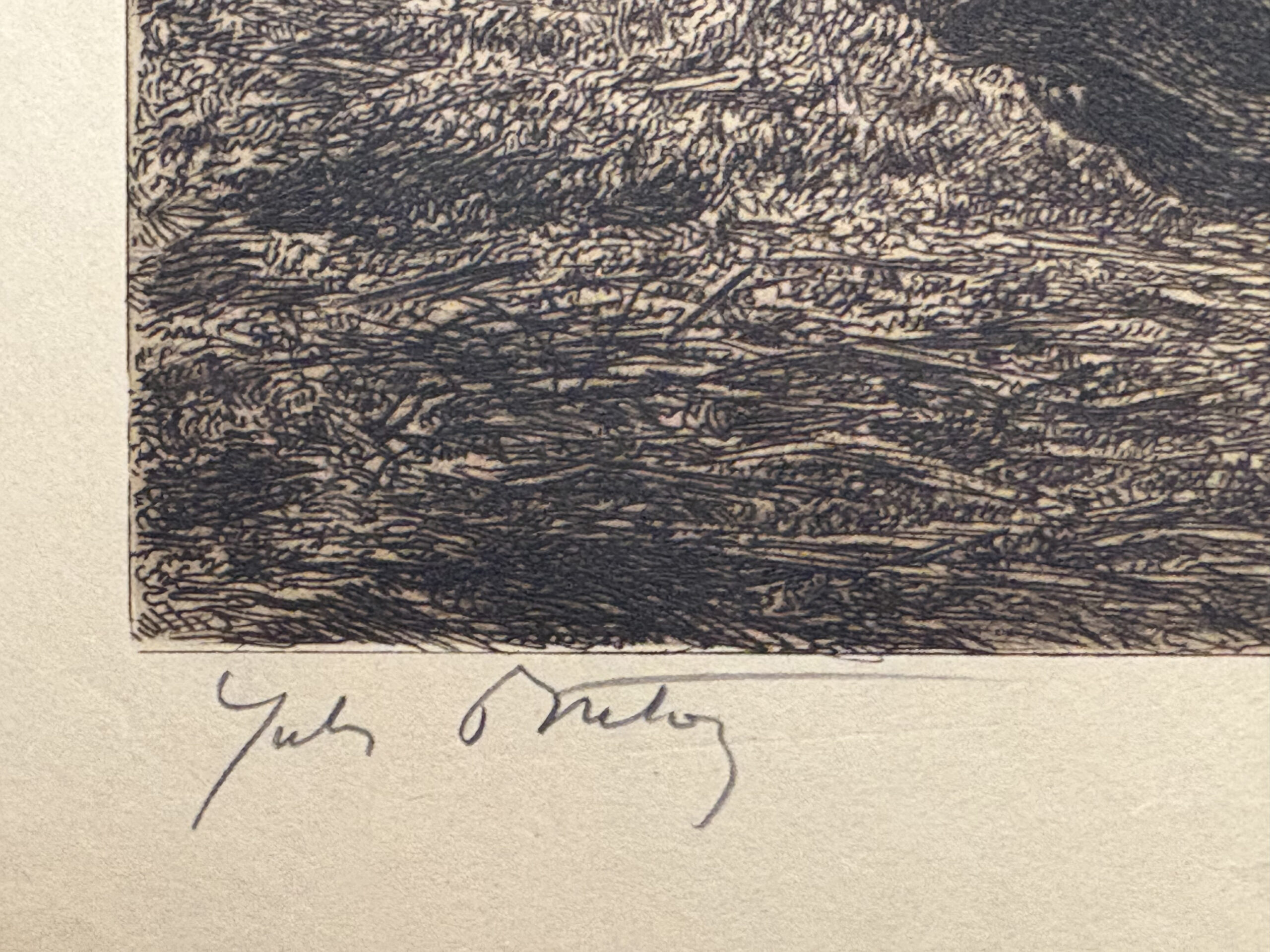
Original etching after the painting of 1887, signed in pencil by Breton, with engraved credits to the publisher in the top margin, printed in brown-black ink on thin, smooth, dark-cream wove paper. Printed by G.W. Ritchie, published by G. Klackner, New York, 1889.
Accession Number187693
NotesJules Breton was born on 1 May 1827 in Courrières, a small Pas-de-Calais village. His father, Marie-Louis Breton, supervised land for a wealthy landowner. His mother died when Jules was four and he was brought up by his father. Other family members who lived in the same house were his maternal grandmother, his younger brother, Émile, and his uncle Boniface Breton. A respect for tradition, a love of the land and for his native region remained central to his art throughout his life and provided the artist with many scenes for his Salon compositions.
His first artistic training was not far from Courrières at the College St. Bertin near Saint-Omer. He met the painter Félix De Vigne in 1842 who, impressed by his youthful talent, persuaded his family to let him study art. Breton left for Ghent in 1843 where he continued to study art at the Academy of Fine Arts with de Vigne and the painter Hendrik Van der Haert. In 1846, Breton moved to Antwerp where he took lessons with Egide Charles Gustave Wappers and spent some time copying the works of Flemish masters. In 1847, he left for Paris where he hoped to perfect his artistic training at the École des Beaux-Arts.
In Paris he studied in the atelier of the Michel Martin Drolling. He met and became friends with several of the Realist painters, including François Bonvin and Gustave Brion and his early entries at the Paris Salon reflected their influence. His first efforts were in historical subjects: Saint Piat preaching in Gaul then, under the influence of the revolution of 1848, he represented Misery and Despair. The Salon displayed his painting Misery and Despair in 1849 and Hunger in 1850–51.
Both paintings have since been destroyed. After Hunger was successfully shown in Brussels and Ghent, Breton moved to Belgium where he met his future wife Elodie. Elodie was the daughter of his early teacher Félix de Vigne. In 1852, Breton returned to France. But he had discovered that he was not born to be a historical painter, and he returned to the memories of nature and of the country which were impressed on him in early youth. In 1853 he exhibited Return of the Reapers, the first of numerous rural peasant scenes influenced by the works of the Swiss painter Louis Léopold Robert. Breton's interest in peasant imagery was well established from then on and what he is best known for today. In 1854, he returned to the village of Courrières where he settled. He began The Gleaners, a work inspired by seasonal field labor and the plight of the less fortunate who were left to gather what remained in the field after the harvest. The Gleaners received a third class medal, which launched Breton's career. He received commissions from the State and many of his works were purchased by the French Art Administration and sent to provincial museums. His 1857 painting Blessing of the Wheat, Artois was exhibited at the Salon the same year and won a second class medal.
Breton married Elodie de Vigne in 1858.
He continued to exhibit throughout the 1870s and into the 1880s and 1890s and his reputation grew. His poetic renderings of single peasant female figures in a landscape, posed against the setting sun, remained very popular, especially in the United States. Since his works were so popular, Breton often produced copies of some of his images. He was extremely popular in his own time, exhibiting numerous compositions at the Salons that were widely available as engravings. He was one of the best known painters of his period in his native France as well as England and the United States.
In 1886, Donald Smith, 1st Baron Strathcona and Mount Royal, bid $45,000 at a New York auction for Breton's work The Communicants (1884). At that time, the price was the second highest price paid for a painting by a living artist. The painting changed hands again in 2016 and commanded $1.27 million.[That figure is very close to the 1886 auction price after adjusting for inflation. Also in 1886, Breton was elected a member of the Institut de France on the death of Baudry.
In 1887 New York art dealer M. Knoedler ordered two paintings from Breton, commissioned Charles Albert Waltner to etch the grand Salon work the Recall of the Gleaners (1859) and then held a special exhibition of his works in 1888.
In 1889 Breton was made commander of the Legion of Honor, and in 1899 foreign member of the Royal Academy of London. His brother Emile, an architect by training, and his daughter Virginie were also painters.
Wounded Seagull (1878) oil on canvas, depicting a woman on the coast of Brittany holding a bird to her breast, with others flying in the distance.
He also wrote several books, and was a recognized writer who published a volume of poems (Jeanne) and several editions of prose relating his life as an artist and the lives of other artists that he personally knew; among them Les Champs et la mer (1876), Nos peintres du siècle (1900), Delphine Bernard (1902), and La Peinture (1904). Breton died in Paris on 5 July 1906.
According to the Encyclopædia Britannica Eleventh Edition 1911, Breton was essentially a painter of rustic life, especially in the province of Artois, which he quit only three times for short excursions: in 1864 to Provence, and in 1865 and 1873 to Brittany, whence he derived some of his happiest studies of religious scenes. His numerous subjects may be divided generally into four classes: labour, rest, rural festivals and religious festivals. Among his more important works, with their location as of 1911, may be named Women Gleaning, and The Day after St Sebastian's Day (1855), which gained him a third-class medal; Blessing the Fields (1857), a second-class medal; Erecting a Calvary (1859), now in the Lille gallery; The Return of the Gleaners (1859), now in the Luxembourg; Evening and Women Weeding (1861), a first-class medal; Grandfather's Birthday (1862); The Close of Day (1865); Harvest (1867); Potato Gatherers (1868); The Weeders (1868); A Pardon, Brittany (1869); The Fountain (1872), medal of honour; The Bonfires of St John (1875); Women mending Nets (1876), in the Douai museum; A Gleaner (1877), Luxembourg; Evening, Finistère (1881); The Song of the Lark (1884); The Last Sunbeam (1885); The Shepherd's Star (1887); The Call Home (1889); The Last Gleanings (1895); Gathering Poppies (1897); The Alarm Cry (1899); Twilight Glory (1900).
(source: wikipedia.org)
| Artist | Breton |
|---|---|
| Nationality | French |
| Category | Barbizon |